Understand how stress can affect your heart rate, blood pressure and overall cardiovascular health.
Learn about six cardiac warning signs, including palpitations, chest pain, breathlessness, dizziness, fatigue and cold sweats.
Explore the link between prolonged stress, abnormal heart rhythms and Broken Heart Syndrome.
Discover how cardiologists diagnose stress-related heart symptoms using ECG, echocardiography and Holter monitoring.
Know when to consult a cardiologist and which symptoms require immediate medical attention.
Your heart starts racing just before an important presentation. You feel a tightness in your chest after a difficult conversation. Or perhaps you notice your heartbeat becoming unusually fast when you’re anxious.
It’s easy to put these experiences down to stress. And sometimes, that’s exactly what they are. Stress triggers physical changes in the body, and the heart responds almost immediately.
But there’s an important distinction to make: not every symptom that appears during a stressful moment is caused by stress.
Palpitations, chest discomfort and breathlessness can also be signs of an underlying heart condition. Some cardiac problems even present in ways that resemble anxiety.
So, can stress actually trigger heart problems? What symptoms should you watch out for? And when is it time to see a cardiologist?
Let’s look at what the evidence tells us.
It can, particularly in people who already have cardiovascular disease or other risk factors.
When you’re under stress, your body releases hormones such as adrenaline. Your heart rate increases, blood pressure rises and the heart has to work harder. This is a normal response that helps you deal with a challenging situation.
However, in someone with narrowed coronary arteries, the increased workload may sometimes make it harder for the heart to get the oxygen-rich blood it needs. This can contribute to myocardial ischaemia, which may cause chest discomfort or angina.
Intense emotional or physical stress has also been associated with certain cardiac conditions, including Takotsubo cardiomyopathy, commonly known as Broken Heart Syndrome.
The name may sound unusual, but Broken Heart Syndrome is a recognised medical condition.
Also known as Takotsubo syndrome or stress cardiomyopathy, it occurs when part of the heart muscle suddenly becomes weakened. This affects the heart’s ability to pump blood effectively.
It often follows an intense emotional or physical experience, such as:
The symptoms can be frighteningly similar to those of a heart attack. A person may experience sudden chest pain, breathlessness and changes in their ECG.
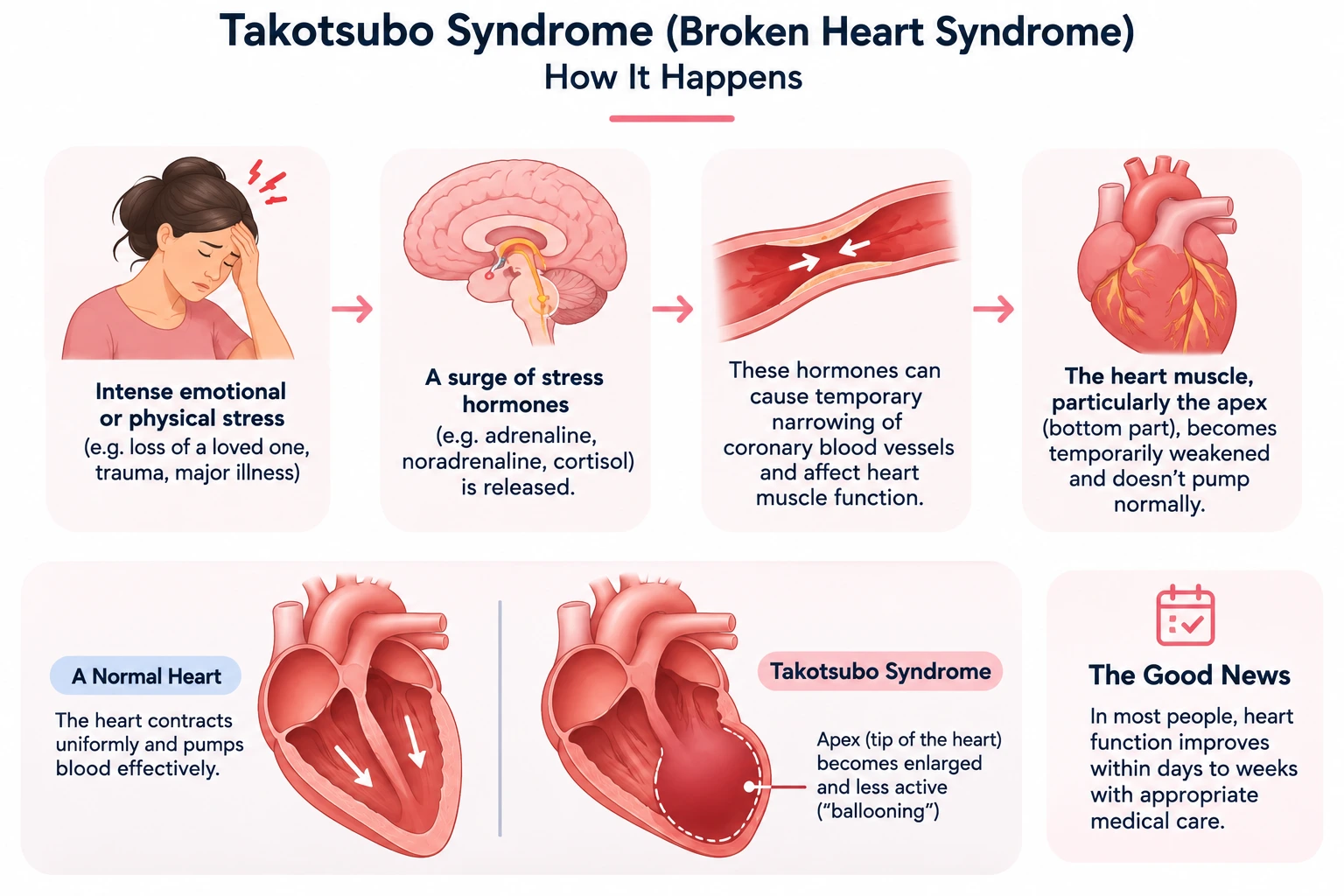
There is an important difference, though. In Takotsubo syndrome, the heart muscle dysfunction usually occurs without an obstructive coronary artery blockage being responsible for it. However, it is not possible to distinguish the two conditions by symptoms alone.
Most people recover their heart function over days or weeks with appropriate medical care. But complications, including heart failure and abnormal heart rhythms, can occur. Sudden chest pain or breathlessness should always be treated as a possible emergency. Do not assume it is simply a reaction to stress.
Stress can affect the way you feel physically. But if symptoms are recurring, persistent or unusual for you, it’s worth finding out what’s causing them. Here are six symptoms that deserve attention.
Have you ever felt as though your heart skipped a beat, fluttered or suddenly started pounding?These sensations are called palpitations. They can happen during periods of anxiety because adrenaline increases the heart rate and makes each heartbeat feel more noticeable.
But stress isn’t the only possible explanation. Palpitations can also be associated with arrhythmias (abnormal heart rhythms), thyroid disorders, anaemia and certain medications.
If they keep coming back, last longer than usual or occur with dizziness, fainting or chest discomfort, speak to a doctor.
Chest tightness during anxiety can feel uncomfortable and sometimes frightening. Muscle tension and changes in breathing may contribute to it.
However, chest discomfort can also be a sign of angina or a heart attack.
Angina occurs when the heart muscle doesn’t receive enough oxygen-rich blood. People may describe it as pressure, heaviness, squeezing or a feeling of tightness in the chest. The discomfort may also spread to the arms, shoulders, jaw or back.
New, unexplained or persistent chest discomfort should never automatically be attributed to stress.
Feeling short of breath during an anxious moment is not uncommon. Some people start breathing faster or feel that they cannot take a satisfying breath.
But breathlessness can have several causes, including coronary artery disease, heart failure, abnormal heart rhythms and lung conditions.
Pay particular attention if it is new, happens during ordinary activities, gets progressively worse or occurs when you’re resting.
Sudden or severe breathlessness, especially with chest pain or fainting, needs emergency medical attention.
A stressful situation can sometimes leave you feeling light-headed. Changes in breathing, heart rate and blood pressure may contribute to this.
However, unexplained dizziness or fainting can also be linked to an abnormal heart rhythm or a sudden drop in blood pressure.
Fainting during physical activity, or alongside palpitations or chest discomfort, should be evaluated promptly. It is particularly important not to dismiss repeated episodes as anxiety.
Most of us feel tired after a demanding week or a few nights of poor sleep. But fatigue that doesn’t improve with rest deserves attention.
Unusual tiredness can sometimes be associated with cardiovascular conditions, including coronary artery disease and heart failure.
You may notice that everyday activities, such as climbing stairs or walking short distances, leave you more exhausted than before.
If this is accompanied by breathlessness, reduced exercise tolerance or swelling in your legs, consult a doctor.
Cold sweats, nausea and sudden weakness can occur during a heart attack. These symptoms are sometimes mistaken for digestive trouble, exhaustion or anxiety.
Heart attack symptoms can vary. Women, older adults and people with diabetes may experience symptoms such as unusual fatigue, breathlessness, nausea or discomfort in the back and jaw, sometimes without prominent chest pain.
There isn’t one test that can tell you whether a symptom is caused by stress. A cardiologist needs to understand what you’re experiencing, when it happens and whether you have any underlying risk factors.
The assessment usually begins with your medical history, a physical examination and a review of your symptoms. Depending on the findings, your doctor may recommend some of the following investigations:
You may not need all these tests. The choice depends on your symptoms, examination and overall cardiac risk.
If you’re experiencing chest pain, sudden breathlessness or other possible heart attack symptoms, don’t wait to see if they settle down or assume they’re caused by anxiety.
Seek emergency medical help if you notice:
These symptoms need urgent assessment even if you’re otherwise healthy or have never been diagnosed with a heart condition.
Stress can make your heart race, bring on palpitations and sometimes cause chest discomfort. In certain circumstances, intense emotional or physical stress may also contribute to triggering a cardiac event.
But it’s important not to make assumptions about what your symptoms mean.
Anxiety and heart conditions can produce similar sensations. The only way to understand what’s happening is to consider the symptoms in context and seek the right medical assessment.
If you’re experiencing recurring palpitations, unexplained breathlessness, unusual fatigue or chest discomfort, speak to a doctor rather than putting it down to a stressful lifestyle.
For a cardiac assessment and guidance on your heart health, consult the cardiology specialists at the CK Birla Hospital. [Booking Link: https://www.ckbhospital.com/book-an-appointment]
Written and Verified by:

Similar Cardiology Blogs
Request a call back


