Understand what a breast self-exam is and why breast awareness matters.
Follow a step-by-step guide to checking your breasts at home.
Learn how to use finger pressure and visual checks to examine breast tissue.
Recognise warning signs such as new lumps, nipple changes and skin dimpling.
Know when to consult a breast specialist and why self-exams do not replace mammograms.
Taking a few minutes to check your breasts could help you notice a change that needs medical attention.
The World Health Organization (WHO) estimates that around 2.4 million women worldwide were diagnosed with breast cancer in 2024, making it one of the most common cancers in women. But when it is found early, treatment has its best chance of working.
A breast self-exam is not a diagnosis, and it does not replace mammograms. But it helps you learn how your breasts normally look and feel, so if something changes, you are the first to notice.
A breast self-exam (BSE) simply means looking and feeling your breasts, and the area around them, including your armpits, to check for anything unusual.
Our breasts are not meant to be perfectly uniform. Their texture, size, and tenderness naturally vary from person to person, and even from week to week. For instance, your breasts may feel fuller before your period or become tender during hormonal changes.Pregnancy, breastfeeding and menopause can also affect how they look and feel.
The purpose of breast self examination is not to diagnose cancer at home or replace recommended screening. Instead, breast awareness can help you recognise changes and seek medical advice promptly.
The WHO guide describes two parts of breast self-examination:
You can do the breast check at home, in a comfortable and well-lit space.
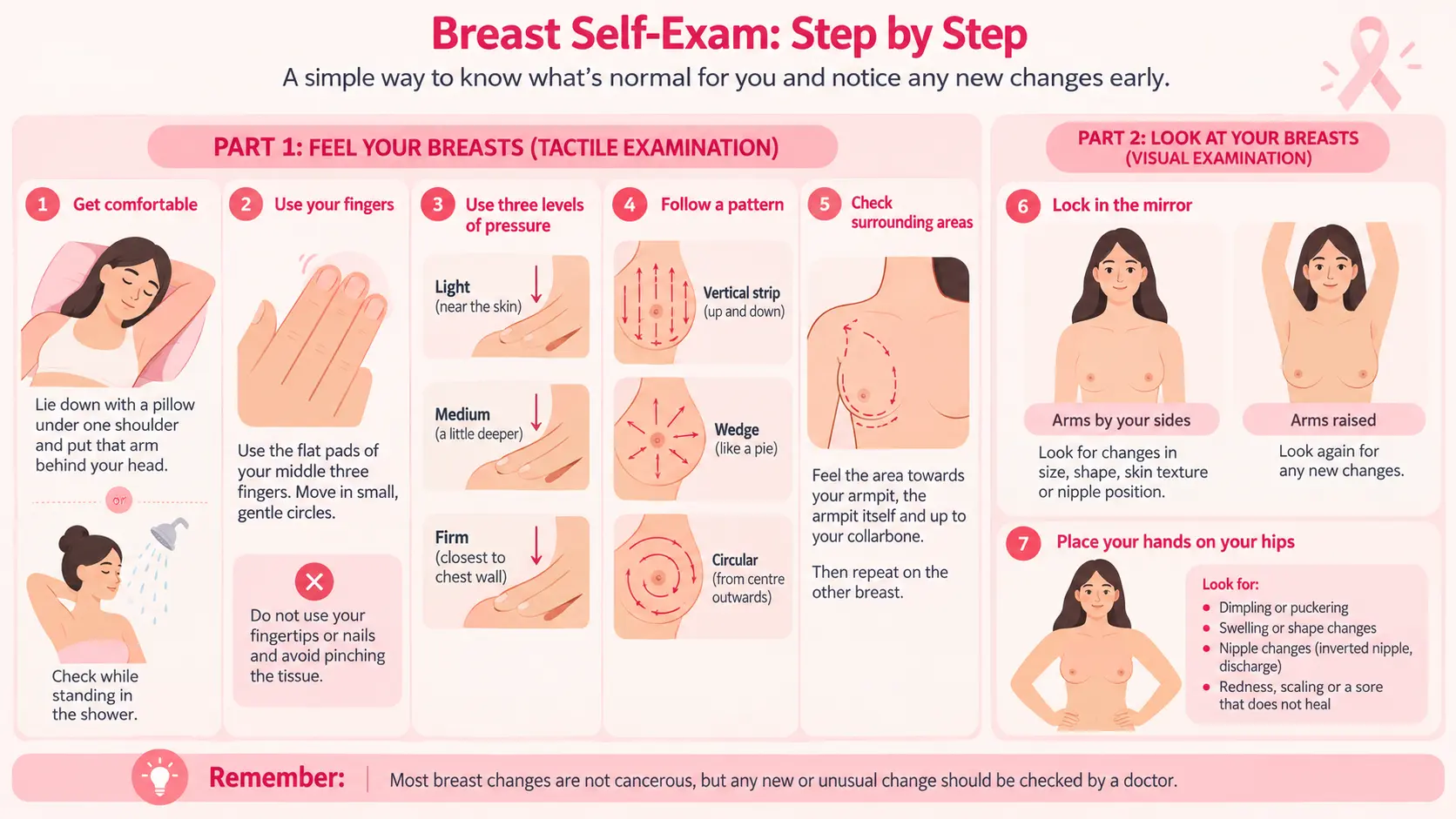
Step 1: Get into a comfortable position
You can check your breasts while lying down or standing in the shower. If you lie down, place a pillow under one shoulder and put that arm behind your head. This helps spread the breast tissue across your chest, making it easier to examine.
Step 2: Use the pads of your fingers
Use the flat pads of your middle three fingers. Move them in small, gentle circles across your breast. Do not use your fingertips or nails and avoid pinching the tissue between your fingers.
Step 3: Use different levels of pressure
As you examine each area, use three levels of pressure:
When you use the different pressure levels, it helps you become familiar with the different layers of breast tissue.
Step 4: Follow a consistent pattern
Choose one of these three patterns to examine the entire breast:
You don’t need to use all three patterns. Choose one that feels easy to follow and use it consistently.
Step 5: Check the surrounding areas
Examine the tissue towards your armpit, the armpit itself and the area extending up to your collarbone. Then repeat the same process on your other breast using the opposite hand.
Visual Examination (Looking at Your Breasts)
Step 6: Look at your breasts with your arms by your sides and raised
Stand in front of a mirror in a well-lit room, with your upper body unclothed. Keep your arms relaxed by your sides and look at both breasts.
Next, raise your arms above your head and look again. Notice any new changes in size, shape, skin texture or nipple position. Mild differences between breasts are common, so focus on changes that are new for you.
Step 7: Place your hands on your hips and look for changes
Now, place your hands on your hips and press gently to tighten your chest muscles. Look for new dimpling, puckering, swelling or changes in the shape of your breasts.
Check your nipples and the surrounding skin, too. Look for a newly inverted nipple, unusual discharge, persistent redness, scaling or a sore that does not heal.
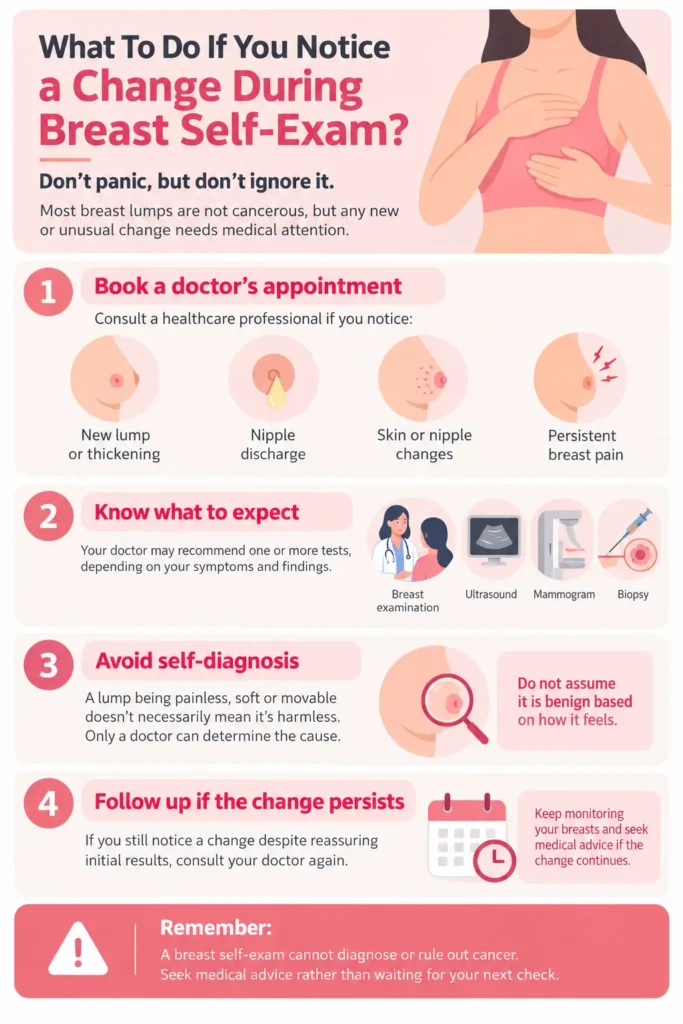
Your breasts do not always need to look or feel identical. Focus on changes that are new, persistent or unusual for you.
Watch for:
Note – According to the American Cancer Society, a new lump is one of the most common signs of breast cancer, but most breast lumps are not cancer. Cysts, fibroadenomas, infections, and hormonal changes can all cause breast changes too.
You can’t tell by touch alone whether a lump is harmless. That’s why it is important to have any new lump checked by a breast specialist, who may recommend imaging tests such as a mammogram or ultrasound to find out what it is.
There is no universally recommended schedule for formal breast self-examination. If you choose to check your breasts regularly, doing so approximately once a month can help you to get familiar with how your breasts normally look and feel.
If you menstruate, try a few days after your period ends, when breasts are usually less tender and swollen.
If you no longer menstruate, pick any day that is easy to remember, like the first of the month.
Keep this in mind:
Self-examination of breasts does not replace screening. When and how often you need a mammogram depends on:
Talk to your breast specialist about a plan that suits you, especially if you have a family history of breast or ovarian cancer, or if you carry an inherited cancer-risk gene.
At the CK Birla Hospital, we have a dedicated ‘Breast Centre’. Whether you have noticed a change, have a family history, or simply want to get checked, you can book a consultation at any time with our breast care specialists.
Written and Verified by:

Similar The Breast Centre Blogs
Request a call back


