Trust img

Home >Blogs >Are Inverted Nipples Normal? Causes & Treatment
CK Birla Hospital

Are Inverted Nipples Normal? Causes & Treatment

Share :

Summary

Inverted nipples are often a normal anatomical variation present from birth, but a newly inverted nipple should always be medically evaluated. This guide explains the common causes, grades, and symptoms of nipple inversion. It also covers non-surgical and surgical treatment options, including breastfeeding considerations. Learn the warning signs that require prompt medical attention to protect your breast health.

A nipple is made up of milk ducts, smooth muscle, nerve endings, and connective tissue. Normally, the nipple projects outward. In some people, the milk ducts are slightly shorter than usual, or fibrous tissue beneath the areola (the dark skin around the nipple) pulls the nipple tip inward, giving it a dimpled or tucked-in appearance.

So, if you have noticed that one or both of your nipples point inward rather than outward, you may have inverted nipples. It is a normal anatomical variation that is present since birth in some people.

Inverted nipples can also change in how they look throughout the day due to temperature, touch, or hormonal shifts. This is completely normal.

Congenital vs. Acquired Inversion

             Congenital Inversion                 Acquired Inversion
  • It is present from birth or noticed during puberty.
  • It affects both nipples in most cases.
  • It is caused by the milk ducts failing to fully elongate during fetal development.
  • This is a normal anatomical variant and is not medically concerning on its own.
  • A nipple that was previously normal and has recently turned inward.
  • This should be considered a red flag for your body and requires prompt evaluation by a doctor.
  • It can point to conditions like infection, inflammation or even breast cancer.

Are Inverted Nipples the Same as Flat Nipples?

No. A flat nipple lays evenly with the surrounding areola. It does not project outward, but it does not retract inward either. An inverted nipple is actively pulled inward.

The two can look similar but have different implications for breastfeeding and treatment.
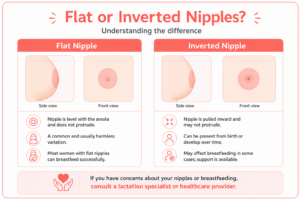
Flat and Inverted Nipples? understand the differnce

7 Common Causes of Nipple Inversion

First, understand what has caused your nipple inversion. Some most common causes of such nipple type are:

  1. Congenital (Born With It)
  • This is by far the most common cause. During fetal development, the milk ducts may not fully elongate, which makes them slightly shorter and pulls the nipple inward.
  • This type of inversion is usually bilateral, affecting both nipples.
  • It remains stable over time, and is not associated with any disease process.
  1. Periductal Mastitis (Breast Duct Inflammation)
  • Periductal mastitis is an inflammation of the tissue surrounding the milk ducts.
  • Over time, inflammation causes scarring (fibrosis) that shortens these ducts and pulls the nipple inward.
  • This condition is generally caused due to excessive smoking, duct blockage, and bacterial infection.
  1. Mammary Duct Ectasia
  • In this condition, milk ducts become inflamed and thickened, due to which the nipples shorten and retract. It commonly occurs around the time of menopause. This may also cause a thick, greenish nipple discharge. It is benign and manageable, but needs a medical evaluation.
  1. Breast Infections and Abscesses
  • Subareolar abscess (a collection of pus beneath the areola)
  • Recurrent episodes of mastitis (breast tissue infection)

These two conditions can also cause scarring that retracts the nipple inward.

  1. Breast Cancer
  • Both the American Cancer Society and the NHS recognise nipple retraction as a potential sign of breast cancer.
  • Certain types of breast tumour, especially those growing close to the nipple or within the ducts, can gradually pull the nipple inward as the tumour grows. This does not mean every inverted nipple is cancer. But it does mean that a new nipple inversion in an adult must not be ignored and should be evaluated timely.
  1. Prior Surgery, Trauma, or Radiation

If you have had breast surgery, a biopsy, breast reduction, or radiation therapy in the past, scar tissue from those procedures can sometimes affect the surrounding ductal tissue and cause the nipple to retract. This type of inversion is usually stable over time.

  1. Aging and Natural Tissue Changes

As we get older, breast tissue naturally loses some of its elasticity. This can lead to mild nipple retraction in older women. It is gradual, affecting both sides, and not linked to any underlying condition. It is a natural part of how breast tissue changes with age.

3 Grades of Nipple Inversion

It is divided into three grades based on the degree of fibrosis.

Grade 1 (Mild)

Grade 1 inverted nipples are sometimes called ‘shy nipples.’ They can be easily pulled outward with light pressure or stimulation and stay out for a little while on their own. The milk ducts are fully intact with little to no fibrous tissue. Breastfeeding is very much possible at this grade.

Grade 2 (Moderate)

At Grade 2, the nipple can still be everted with some manual effort. However, it retracts back quickly. There is some fibrosis present beneath the nipple. Breastfeeding is possible but may need extra support.

Grade 3 (Severe)

Here, the nipple cannot be everted manually at all. There is noticeable fibrosis and shortening of the milk ducts beneath. Surgery is generally the recommended path forward at this stage.
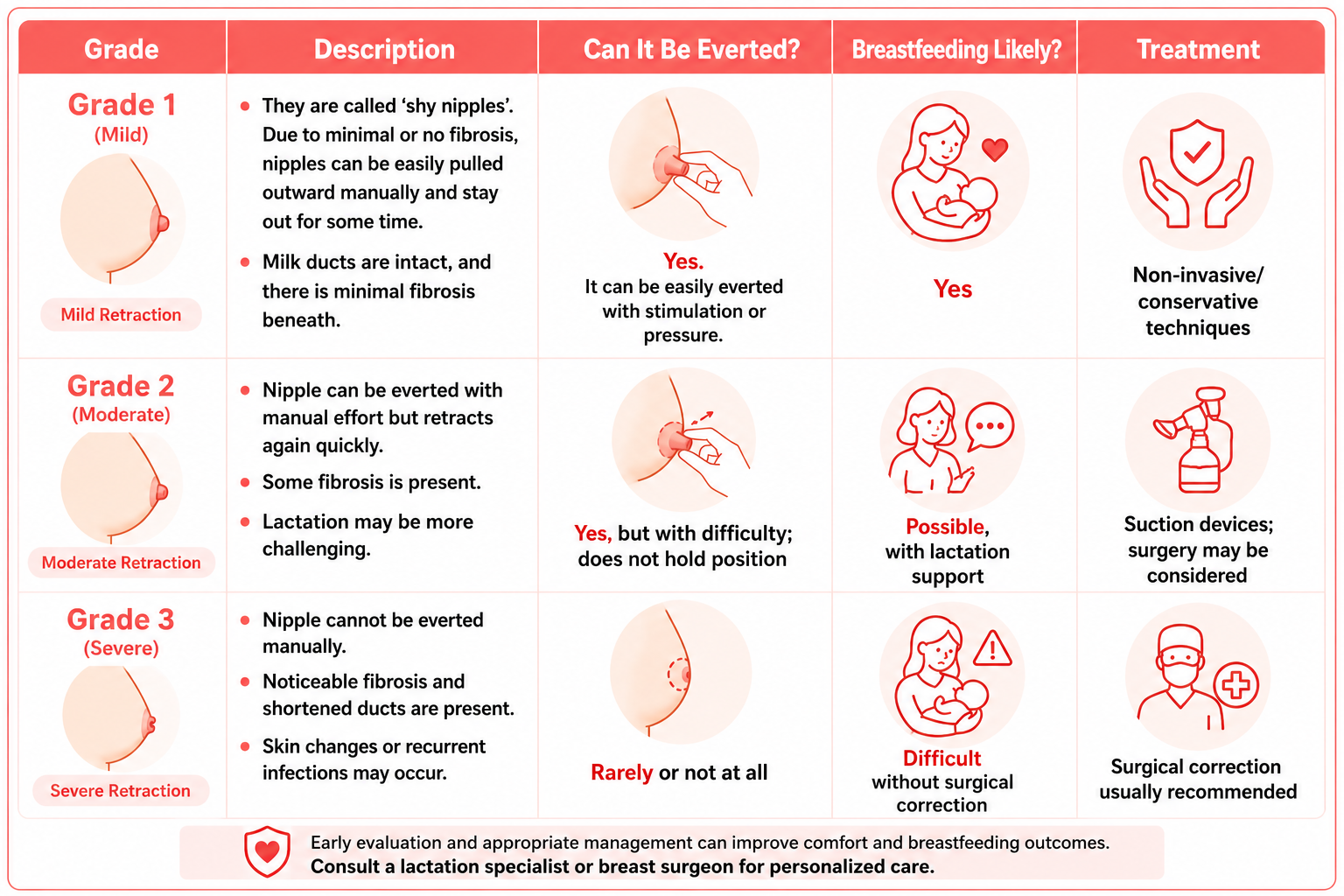
3 Grades of Nipple Inversion

Most people with congenital inverted nipples (those who have since birth) have Grade 1 or Grade 2 inversion. Grade 3 is less common and is more frequently associated with acquired causes such as chronic infection or significant fibrosis.

Treatment for Inverted Nipples

The treatment for inverted nipples depends majorly on its grade and the root cause. Based on your overall condition, you may be suggested any of these treatment approaches.

Non-Surgical Options

Most effective for Grade 1 inversions and mild Grade 2 cases. 
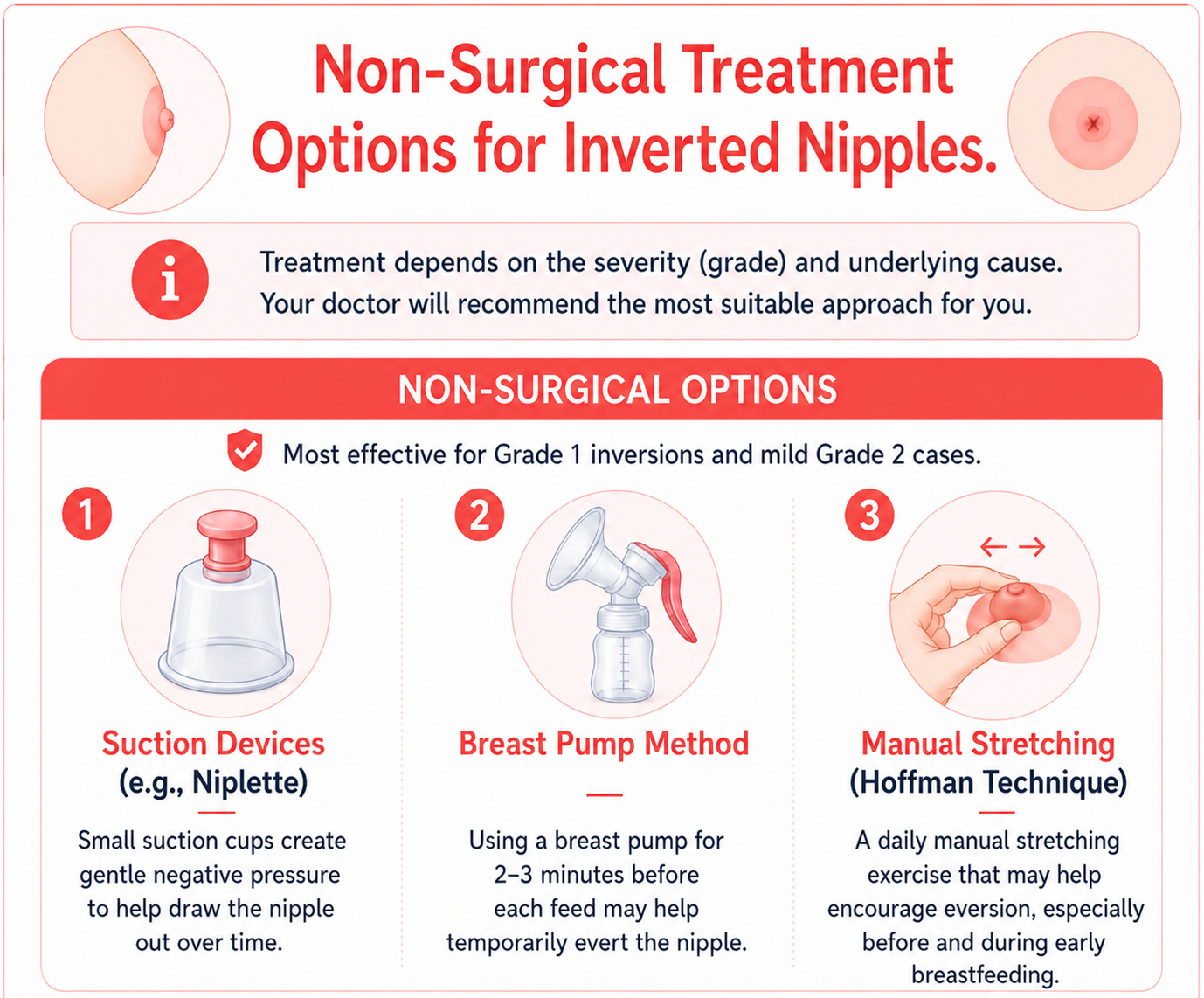
  1. Suction devices (e.g., Niplette)
  • Small suction cups that fit over the nipple and apply gentle, sustained negative pressure to encourage eversion.
  1. Breast pump method
  • When you use a breast pump for 2 to 3 minutes before each feed session, it can temporarily evert your nipples.
  1. Hoffman technique
  • It is a daily manual stretching exercise for congenital inversion, particularly before and during early breastfeeding.

Non-Surgical Treatment Options for Inverted Nipples

Surgical Options

There are two approaches your breast surgeon may discuss with you:
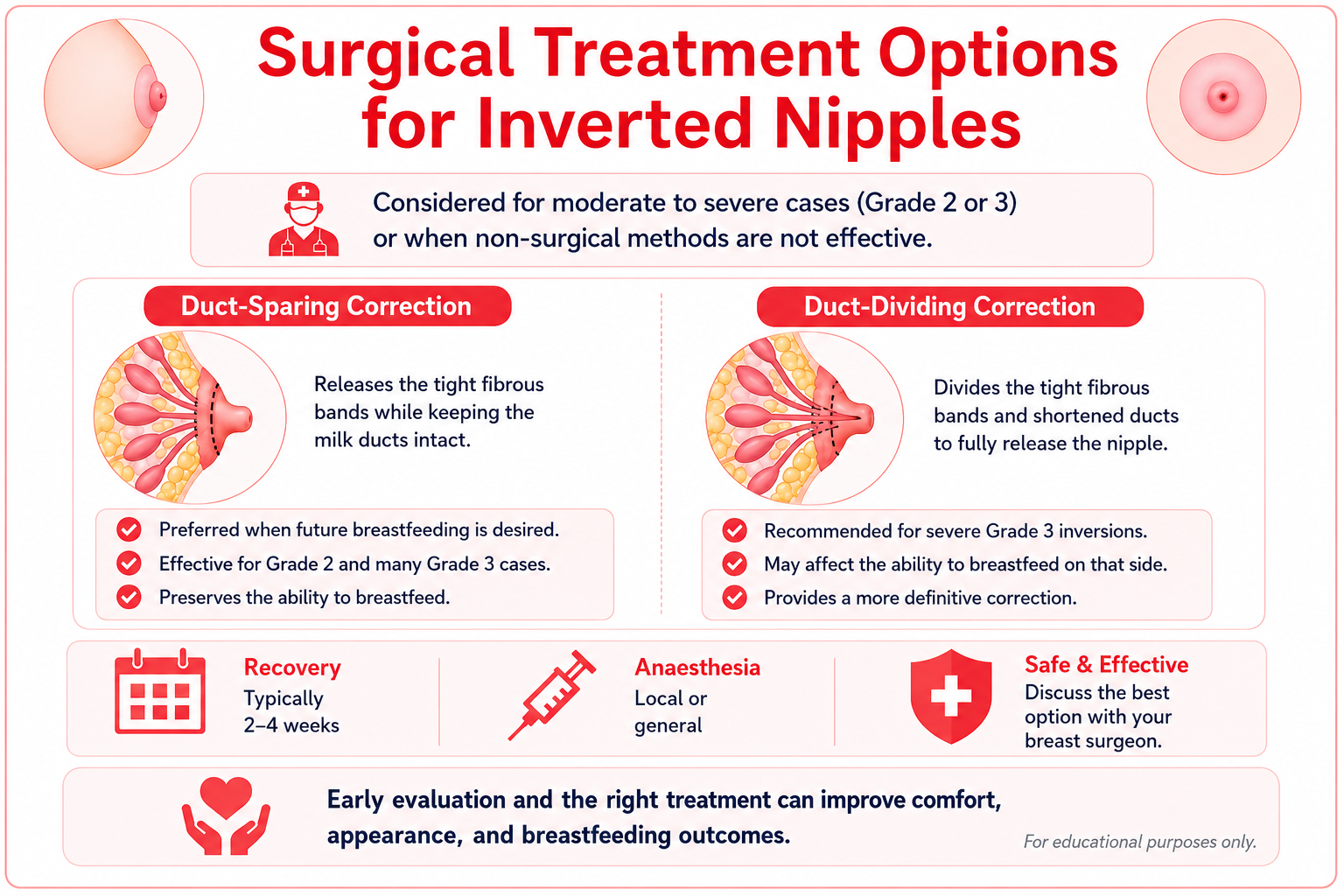
  1. Duct-sparing correction keeps the milk ducts intact while releasing the fibrous bands pulling the nipple inward. If there is any chance you may want to breastfeed in the future, this is generally the preferred route. It works well for Grade 2 and many Grade 3 cases.
  2. Duct-dividing correction is another surgical option where both the fibrous bands and the shortened milk ducts are divided to fully release the nipple. It is usually recommended for severe Grade 3 inversion where other approaches may not be enough. Do keep in mind that this does affect the ability to breastfeed on that side. Recovery usually takes around 2 to 4 weeks, and the procedure is carried out under local or general anaesthesia.

Surgical Treatment options for Inverted Nipples

Important: If you are considering nipple correction surgery and have any future plans to breastfeed, discuss this before the procedure, not after. Your surgeon needs to know, as it affects which technique is used. Once duct-dividing surgery has been performed, breastfeeding on that side is generally no longer possible.

When to Consult a Doctor

You should see a doctor promptly if you notice:

  1. A nipple that was previously normal and has recently turned inward (especially if you are over 40)
  2. Inversion affecting only one nipple (unilateral) with no prior history
  3. Nipple discharge, particularly if it is bloody, clear, or occurs without squeezing
  4. Śkin dimpling , redness or thickening around the nipple or areola
  5. A lump or mass that you can feel beneath or near the areola
  6. Pain, warmth, or swelling in the breast alongside a new nipple change

If you have had lifelong inverted nipples, no new symptoms, and no other breast changes, a routine mention to your doctor is sufficient. The breast care specialist will advise on regular breast screening as appropriate for your age and risk profile.

At Last

If you have noticed a recent change in your nipple and are struggling to figure out the reason behind it, the expert team of experienced breast specialists, gynecologists, and reconstructive surgeons at the CK Birla Hospital is here to help you. Our dedicated ‘Breast Centre’ provides compassionate care in a safe and private setting. You can book a consultation for early detection.

FAQs

Is an inverted nipple normal?

Yes. When it has been present since birth or adolescence and has not changed, a bilateral inverted nipple is a normal anatomical variation. But if your nipple has recently changed, that is when a medical evaluation is needed.

Can a nipple become inverted after pregnancy or breastfeeding?

Yes, this can happen. Breastfeeding puts the breast through significant changes such as engorgement, repeated feeding, and eventual deflation of breast tissue. All of these changes can occasionally alter the way the nipples are present. Repeated breast infections (mastitis) during breastfeeding can also leave behind minor scarring that gradually draws the nipple inward.

Can you breastfeed with inverted nipples?

Women with Grade 1 inversion can usually breastfeed without any intervention. Those with Grade 2 inversion may succeed with practical support such as using a breast pump before feeds to temporarily evert the nipple, or wearing nipple shields during feeding. Grade 3 inversion makes breastfeeding more challenging, and surgical correction may be discussed with this goal in mind.

What age do nipples usually invert?

Congenital nipple inversion is first noticed during puberty, when breast development begins and the nipple architecture becomes apparent. Some people notice it only in adulthood. If nipple inversion appears for the first time in a woman over 40 with no prior history, this should always be evaluated without any delay.

Share :

Written and Verified by:

MBBS, MS - General Surgery, MRCS (UK), Fellowship in Breast Surgery Dr. Rohan Khandelwal is a dynamic and talented breast cancer surgeon and specialises in benign and cancerous breast disorders. He brings over 18+ years of experience and had done more than 800+ breast cancer surgeries. Dr. Rohan has authored 22 articles in various national and international journals, authored 1...