
Even a small, unusual change in your body can raise concerns, especially when it involves your breasts. If you have noticed nipple discharge, it is natural for your mind to jump to worst-case scenarios, particularly after looking up symptoms online and coming across possibilities like breast cancer.
But is every case of nipple discharge really a sign of something serious, or is this a situation where worry outweighs reality?
If you have found yourself asking these questions, understanding what is normal, what is not, and when to seek medical advice can help you find the right guidance.
Nipple discharge refers to any fluid that comes out of the nipple. It may happen when pressure is applied to the breast or, in some cases, without any pressure at all. What your nipple discharge indicates mainly depends on its colour, texture and frequency.
As stated by the National Library of Medicine, nipple discharge is the third most common breast complaint after breast pain and breast mass. Around 50% to 80% of women in their reproductive years experience nipple discharge.
But is nipple discharge normal? In certain situations, yes! For example, nipple discharge during pregnancy or breastfeeding is completely expected. Even outside of these phases, occasional discharge can occur due to hormonal changes. But if you are dealing with frequent nipple discharge without pregnancy or breastfeeding, it should be discussed with a gynaecologist, or breast specialist.
Also Read: Anterior Placenta: What is it? Diagnosis & Complications
Nipple discharge does not look or feel the same for everyone. Its colour and texture may vary from person to person. These differences provide important clues about what your body is trying to communicate.
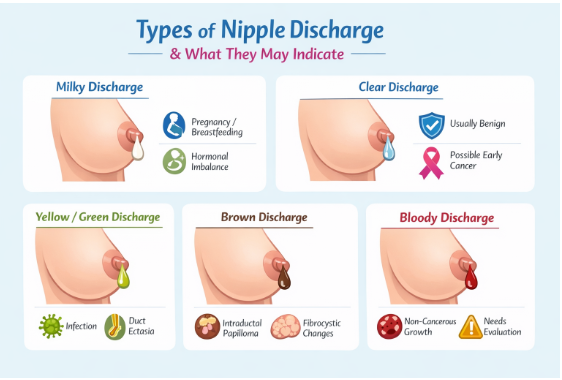
It is common during pregnancy or breastfeeding. If it occurs otherwise, it may be due to hormonal changes, such as high prolactin levels.
A watery or transparent fluid leaks from one breast without squeezing. It is usually not dangerous, but persistent or spontaneous discharge should be evaluated and discussed with a medical professional, as it can occasionally be related to duct carcinoma, which is an early stage of breast cancer.
If the discharge is yellowish, greenish or pus-like, it may indicate mild infections or signs of duct ectasia, which is a non-concerous condition where milk ducts widen and thicken.
It generally happens due to old blood or debris in the milk ducts. It may be linked to conditions like intraductal papilloma (lumps in the milk ducts), duct ectasia (widening of ducts), or fibrocystic breast changes (thickening of breast tissues).
This can feel alarming and should always be checked. While it is often due to non-cancerous growths, it always deserves medical evaluation to rule out more serious causes.
Also Read: What is Mastitis? It’s Causes, Symptoms, Diagnosis, Prevention and Treatment
There are many nipple discharge causes, and most are not related to breast cancer. Here are some of the more common ones:
In many cases, more than one factor may be involved. While most causes do not cause any serious harm, it is still important to stay aware of any unusual changes.
So, when should you actually be concerned? Let’s figure it out in the next section.
Also Read: Can Long-Term Junk Food Habits Raise Your Breast Cancer Risk?
If you notice any of the following, it is important to get checked by a breast specialist or a gynaecologist.
Also Read: Prioritising Early Detection of Breast Cancer: Breast Cancer Awareness
Certainly, any unusual change in the breast, like nipple discharge, can make you feel stressed and it is natural for your mind to link it to breast cancer. However, not all discharges are related to breast cancer.
According to the National Library of Medicine, 97% of nipple discharges cases are benign (non-cancerous). Only a small percentage are linked to breast cancer, and even then, it is usually accompanied by other signs such as a lump or abnormal imaging findings.
Breast cancer-related discharge is more likely to occur on its own, without any pressure, and from one breast. The discharge can be bloody or clear. Still, even these signs can be caused by non-cancerous conditions. Therefore, it is better to consult a healthcare professional if you experience any abnormality in the breast.
The diagnosis of the causes behind your nipple discharge may involve the following:
These steps help identify whether the discharge is due to a harmless condition or something that needs treatment.
Although nipple discharge is generally harmless, it is important not to self-diagnose or self-medicate. Consulting a breast specialist or a gynaecologist can help you find out the cause and choose the right course of care.
Also Read: Postpartum Hemorrhage: Causes, Stages, Duration & When to seek medical help
You should definitely consult a doctor if:
If you are dealing with any of the given situations, you should definitely speak with a gynaecologist or breast specialist doctor. They will identify the cause behind your condition and plan a dedicated treatment for you.
Also Read: When To Worry About Breast Lumps
Noticing unusual discharge from the nipple may feel concerning at first. However, by paying attention to your body without jumping to conclusions and seeking the right medical guidance can help you feel at ease and get the care you need.
If you have any concerns, you can consult the expert gynaecologists and breast care specialists at the CK Birla Hospital, Gurgaon. Our dedicated ‘Breast Centre’ provides world-class comprehensive care for all breast health needs.
Can nipple discharge happen without squeezing the breast?
Yes. Spontaneous discharge (without squeezing) can occur and should be evaluated, especially if it is persistent or one-sided. In such cases, you should seek medical advice without any delay.
Is nipple discharge normal during menopause?
Usually, it is less common, but it can still happen due to hormonal changes. However, new discharge after menopause should always be checked.
Can men experience nipple discharge?
Yes, although it is very rare. In men, nipple discharge should always be evaluated promptly.
Does the smell of nipple discharge indicate a problem?
A foul smell may point to an infection and should be assessed by a breast specialist doctor.
Can stress cause nipple discharge?
Yes, it can affect but not directly. Stress can affect hormone levels in your body, which may indirectly lead to discharge in some cases.
Is it safe to ignore occasional nipple discharge?
If it is mild, occurs only when squeezed, and affects both breasts, it is often harmless. Still, if you are unsure, it is always wise to consult a doctor.
Written and Verified by:

Similar The Breast Centre Blogs
Request a call back


