
“Does radiation therapy hurt?” “Will I lose my hair?” “Will I be able to live a normal life after treatment?”
These are just a few of the many questions people have when they first hear the term radiation therapy. While it is a widely used and effective cancer treatment, it is also surrounded by myths and misconceptions that can make it seem far more intimidating than it really is.
Learning more about radiation therapy can help clear up common confusions and ease unnecessary worries. So, let’s separate fact from fiction and understand how radiation therapy works, its possible side effects and some practical tips to help you feel more prepared and informed.
Keep reading to learn more!
Breast surgery removes the visible tumor, but tiny, microscopic cancer cells can sometimes remain behind. These cells are too small to be seen on scans or during surgery. Radiation therapy is designed to eliminate these remaining cells before they have a chance to grow.
Radiation therapy for breast cancer uses carefully targeted high energy rays, such as , gamma rays, or proton beams to destroy cancer cells that may remain after surgery.
It lowers the risk of the cancer coming back while preserving as much healthy tissue as possible.
Unlike chemotherapy, which travels throughout the body, radiation therapy is a local treatment. That means it focuses only on the breast, chest wall, or nearby lymph nodes where cancer cells may still be present.
Radiation therapy works by damaging the DNA inside cancer cells.
Inside every cell is DNA, which contains the genetic instructions needed for the cell to grow, divide and repair itself. Radiation therapy damages this DNA in cancer cells, preventing them from continuing to multiply.
During the therapy, healthy cells can also be exposed to small amounts of radiation, but unlike cancer cells, they are generally much better at repairing themselves.
This is why radiation treatment is carefully planned before your first session. Advanced imaging and computer-guided technology help your radiation oncology team deliver treatment as accurately as possible.
An overlooked fact: Many people assume radiation works immediately. In reality, cancer cells continue to die gradually over days and weeks after each treatment. That is one reason radiation is given over multiple sessions instead of all at once.
There are two main types of radiation therapy used to treat breast cancer: External Beam Radiation Therapy (EBRT) and Internal Radiation Therapy. Your radiation oncologist will recommend the approach that best suits your diagnosis.
This is the most common form of radiotherapy for breast cancer.
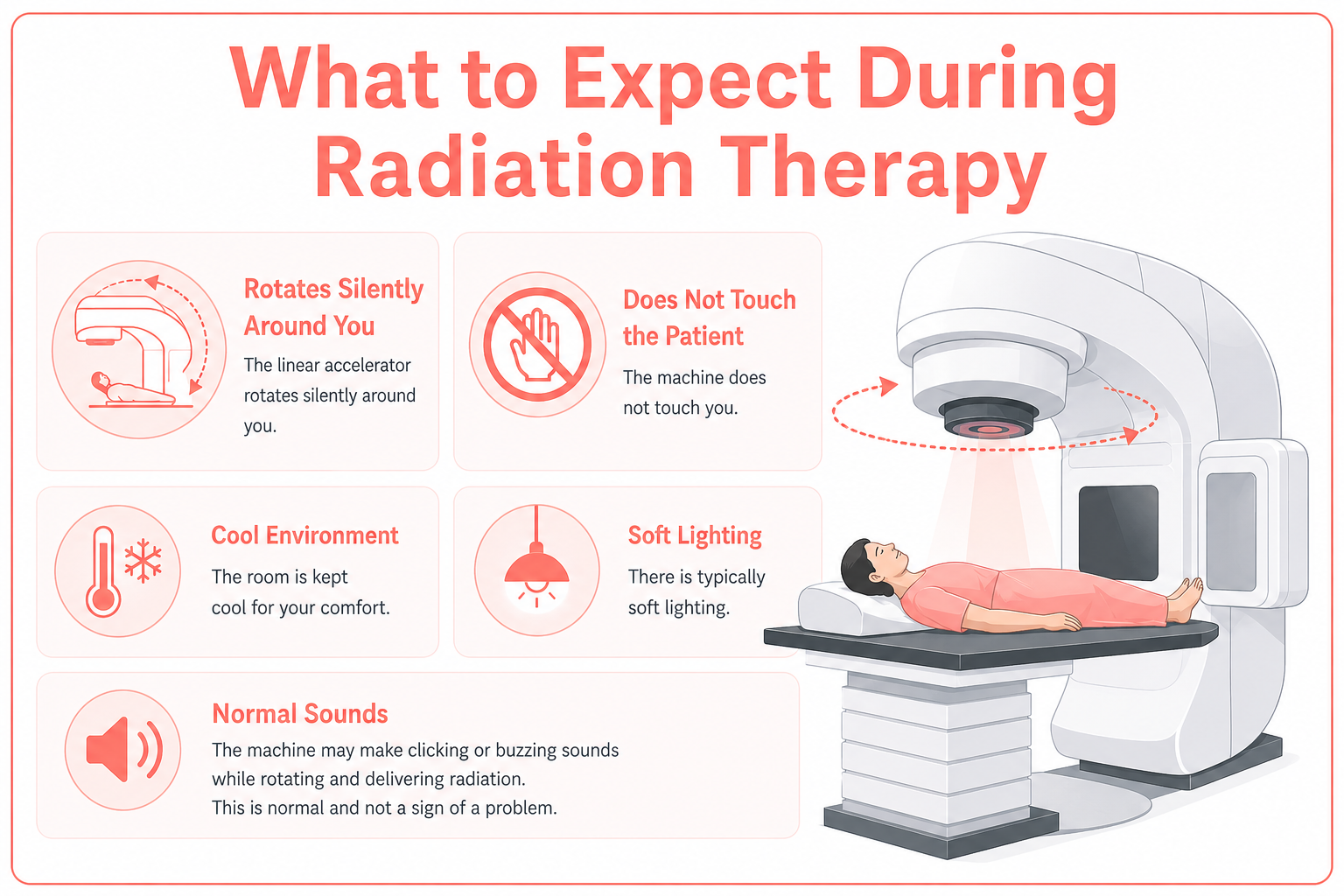
In EBRT, a specialised machine called a linear accelerator delivers high-energy radiation to the treatment area from outside the body.
The machine does not touch you and you won’t feel the radiation during the treatment. Modern radiation techniques allow doctors to precisely shape and target the radiation beam, helping minimise exposure to nearby healthy tissues and organs.
Brachytherapy places a small radioactive source inside or very close to where the tumor was removed.
By targeting the treatment area directly, some people with early-stage breast cancer may be able to complete treatment in a shorter time.
Your doctor may advise radiation if you:
Treatment decisions are usually made by a multidisciplinary team, which may involve a breast surgeon, medical oncologist, radiation oncologist, radiologist, pathologist and other specialists.
Before treatment begins, you will need to attend a planning appointment called a simulation. During this visit, a CT scan is used to map the exact area that needs treatment. Small skin markings may be placed to help position you accurately each day. Actual treatment begins 5 to 10 days later, after the dedicated healthcare team finalises the treatment plan.
Each treatment session follows a routine:
The patient changes into a gown and removes jewelry or clothing from the treatment area.
Technicians carefully position the patient, usually lying on their back with one or both arms raised overhead, to match the exact position from simulation. The markings are aligned with laser lights in the room.
X-rays or scans are done to confirm the breast tissue is in the correct position before radiation begins. For some patients with left-sided breast cancer, Deep Inspiration Breath Hold (DIBH) may be used. Holding a deep breath during treatment helps move the heart away from the radiation field, reducing radiation exposure to the heart.
The machine, called linear accelerator (LINAC), rotates around the patient and delivers beams from multiple angles. The patient lies still and breathes normally (or holds breath, if required). The radiation itself is completely painless and invisible. There is no sensation during delivery.
When the session ends, the machine stops. No recovery time is needed.
Certainly, everyone’s experience is a little different. Some people have very mild symptoms, while others notice more changes as treatment progresses. Most side effects develop gradually, usually after the first week or two, rather than immediately after the first session.
Fortunately, many of these effects are temporary and improve within a few weeks after treatment ends.
The treated skin may become:
These changes are usually mild and usually feel similar to a mild sunburn.
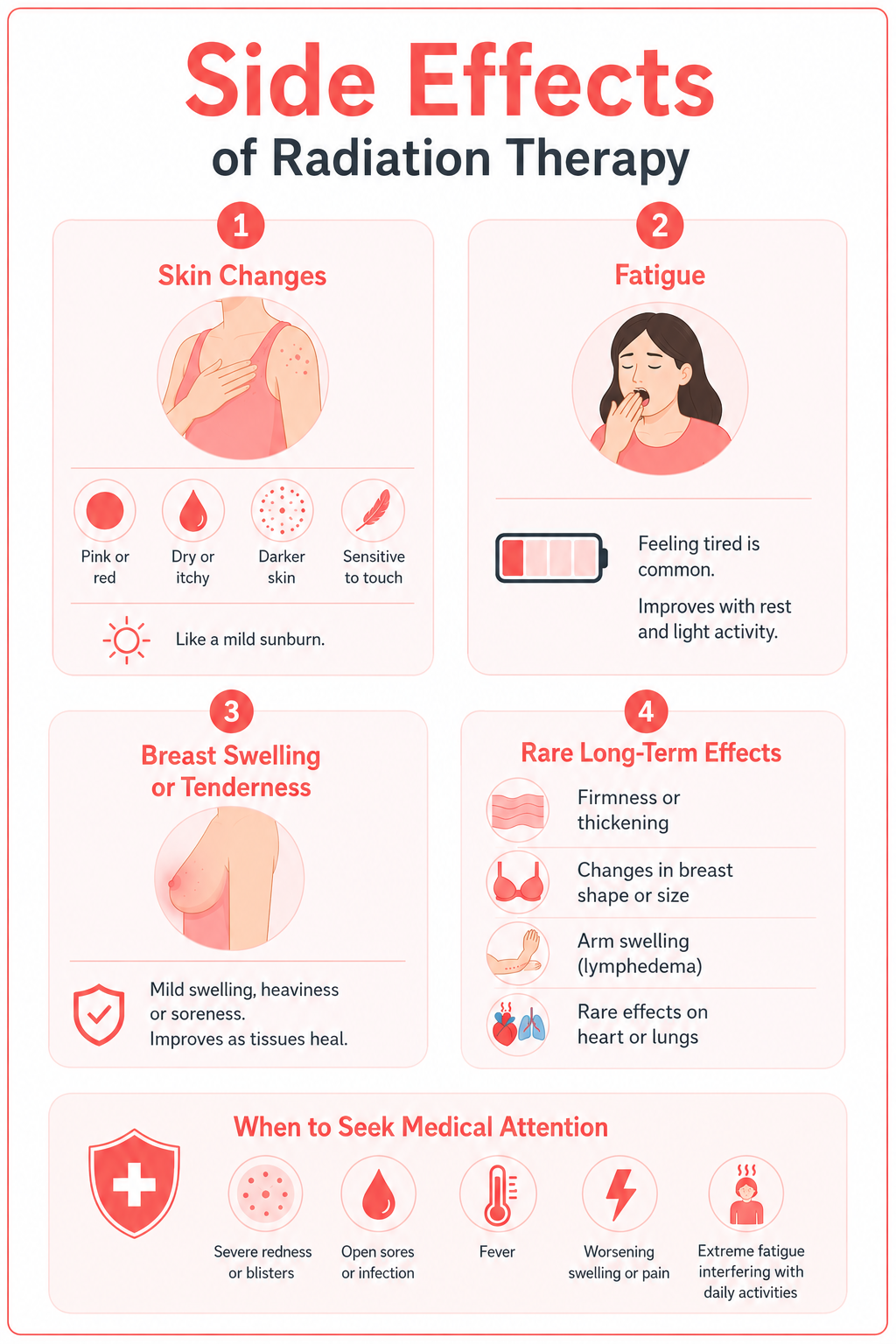
Feeling tired is one of the most common side effects of radiation therapy. This fatigue improves with rest and light physical activity.
Some people experience mild swelling, heaviness or soreness in the treated breast. These symptoms generally improve as the tissues heal.
Long-term side effects are uncommon but may include:
Many patients expect the worst side effects to happen during the first few days. In reality, skin changes and fatigue buildup gradually and peak towards the end of treatment or even one to two weeks after it finishes. Knowing this can help you plan your work, travel, or family commitments more comfortably.
Small changes to your daily routine can make treatment much more comfortable. Here are a few simple tips that many patients find helpful:
Both treatments are used to treat cancer, but they work in different ways.
| Radiation Therapy | Chemotherapy |
| Treats a specific area of the body | Travels throughout the body |
| Uses high-energy radiation | Uses anti-cancer medicines |
| Often follows surgery | May be given before or after surgery |
| Treatment is painless | Medicines may have different side effects |
| Common side effects include skin irritation and fatigue | Common side effects include nausea, hair loss, and a lower immunity |
The treatment that is right for you depends on your individual diagnosis. Your healthcare team will recommend a personalised plan based on the type of breast cancer, its stage and other important factors.
The more you understand about your treatment, the easier it becomes to approach each appointment. Don’t hesitate to ask questions, share your concerns or let your care team know how you are feeling throughout the treatment process.
If you want to learn more about your treatment options or discuss your concerns with an expert, the Department of Oncology at the CK Birla Hospital, along with our multidisciplinary team of specialists, is here to provide personalised and comprehensive care. We will take the time to answer your questions, guide you through your treatment options, and support you at every stage of your journey.
To speak with one of our specialists, book a consultation.
Written and Verified by:

Similar The Breast Centre Blogs
Request a call back


