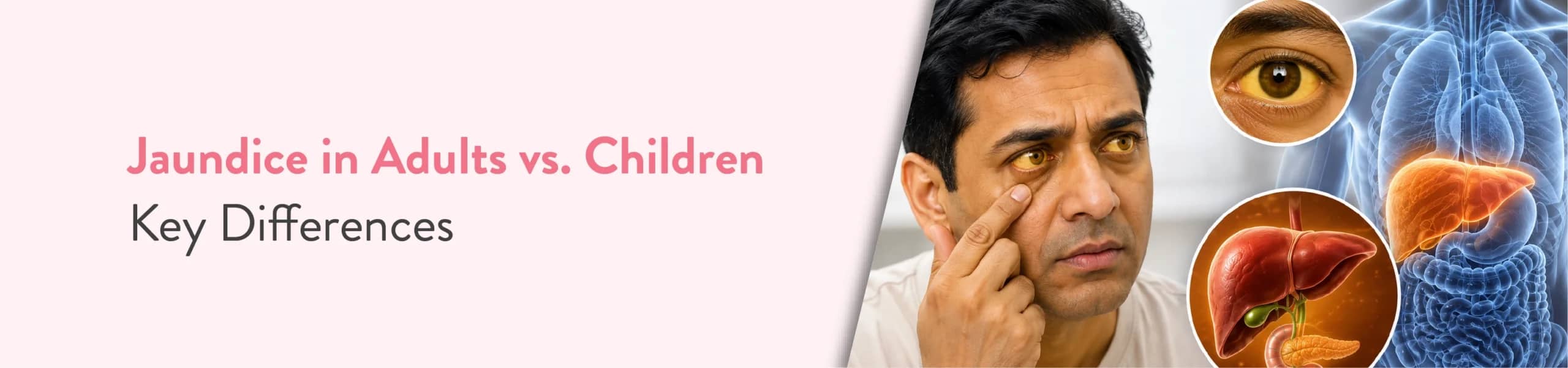
Jaundice is yellow discoloration of the skin and eyes from bilirubin buildup. In newborns, it's usually physiological and temporary. In adults and older children, it's not normal and can indicate hepatitis, gallstones, alcohol-related liver disease, or cirrhosis always warranting medical evaluation.
Yellow is a happy, joyous colour. It reminds us of sunflowers, sunshine and smiley faces. But when it shows up on your skin, eyes, or nails, it is not a happy sign. It is a warning sign.
This could be jaundice, and its causes and consequences vary widely from person to person. What causes jaundice in a newborn is very different from what causes it in an adult, and the treatment differs too.
In this blog, we will break down how jaundice differs between children and adults, including the causes, the symptoms, and when it is time to see a doctor.
Jaundice is a symptom, not a disease. It causes the skin and the whites of the eyes to become yellow because a substance called bilirubin has built up in the blood.
Bilirubin is produced naturally when old red blood cells break down. This process releases hemoglobin, the protein that carries oxygen in the blood, which the body then converts into bilirubin. The liver normally processes it and passes it into bile, which eventually leaves the body through the stool.
Jaundice affects you when too much bilirubin is produced, the liver cannot process it properly, or bile flow is blocked. This is why the same yellow appearance can have very different causes in a newborn, an older child and an adult.
Jaundice in Newborns: It is particularly common during the newborn period. According to NICE (National Institute for Health and Care Excellence), around 60% of full-term babies and 80% of premature babies develop jaundice during the first week of life. Most cases are physiological, meaning they result from normal immaturity of the newborn’s liver and resolve without causing harm.
Jaundice in Older Child: Jaundice in an older child is less expected. But if the symptoms are particularly accompanied by fever, abdominal pain, dark urine or pale stools, it should be medically evaluated on time.
Jaundice in Adults:In adults, jaundice is not considered a normal age-related change. New yellowing of the skin or eyes should be medically evaluated because it can occur with hepatitis, alcohol-related liver disease, gallstones, medication-related liver injury, cirrhosis and other conditions.
Fatty liver disease affects a person when excess fat accumulates in the liver. Mild fatty liver disease does not usually cause jaundice, so visible yellowing should not be blamed on fatty liver alone. Jaundice may develop when the disease progresses to significant liver inflammation, advanced fibrosis or cirrhosis, which can impair the liver’s ability to process bilirubin.
A gallstone can block the flow of bile from the gallbladder into the intestine. This may cause jaundice along with dark urine, pale stools, itching or pain in the upper abdomen. Other blockages can also affect bile drainage.
Cirrhosis is advanced scarring of the liver. It can develop after years of conditions such as chronic viral hepatitis, alcohol-related liver disease or other chronic liver disorders. As liver function declines, bilirubin may accumulate.
Certain medicines can injure the liver and cause jaundice. This is why a doctor should review all prescription medicines, over-the-counter drugs and supplements when evaluating jaundice.
The causes depend strongly on the child’s age.
A newborn’s liver is still developing and may not process bilirubin as efficiently as an older child’s liver. Physiological jaundice usually appears after the first 24 hours of life that needs quick medical attention. It improves as bilirubin processing becomes more efficient. Most babies with uncomplicated jaundice improve within about 10 to 14 days.
Breastfeeding jaundice can occur when a newborn is not taking in enough milk, often during the first week. Breast milk jaundice is different and may persist for longer because substances in breast milk can affect bilirubin processing. This does not mean that you should stop breastfeeding. But, feeding adequacy and the baby’s bilirubin level should be assessed by a healthcare professional.
Sometimes the baby’s blood type does not match the mother’s, a condition called Rh or ABO incompatibility. This causes the baby’s red blood cells to break down faster than normal, leading to a rise in bilirubin and, often, noticeable jaundice.
Glucose-6-phosphate dehydrogenase (G6PD) deficiency is an inherited condition that can make red blood cells more vulnerable to breakdown. It is an important risk factor for severe neonatal hyperbilirubinemia (excess of bilirubin in the blood of a newborn).
In this rare condition, the bile ducts become scarred and blocked, stopping bile from reaching the intestine. If jaundice persists, particularly alongside pale, grey, or white stools and dark urine, it should be checked by a doctor as soon as possible.
Certain infections can also cause jaundice in newborns and children. A jaundiced child who is unwell, feverish, unusually sleepy or feeding poorly needs timely medical assessment.
The most recognisable symptom is yellowing of the whites of the eyes and skin.
In newborns, the yellow colour usually begins around the face and may extend towards the chest, abdomen, arms and legs as bilirubin rises. However, visual assessment alone is not reliable enough to determine bilirubin severity.
Other symptoms are:
A high-pitched cry, abnormal stiffness or floppiness, difficulty waking, seizures or feeding difficulty in a jaundiced newborn are warning signs requiring urgent medical attention because severe bilirubin elevation can affect the brain.
Diagnosis begins by determining how high the bilirubin is and why it has increased.
Depending on age and symptoms, evaluation may include:
For newborns, treatment decisions are based on bilirubin measurements interpreted according to the baby’s age in hours and risk factors.
Jaundice treatment in adults depends on the underlying cause. Treatment may involve:
Once the underlying problem is treated, bilirubin often falls and jaundice improves.
You should seek urgent medical care if jaundice is accompanied by confusion, severe abdominal pain, frequent vomiting, fever, vomiting blood, marked drowsiness or other signs of serious illness.
For newborns, seek urgent assessment if jaundice appears during the first 24 hours, is rapidly worsening, or occurs with poor feeding, difficulty waking, abnormal muscle tone, a high-pitched cry, fever or very dark urine and pale stools.
One warning sign that is easy to miss is pale or white stool in a jaundiced baby. It can mean bile is not reaching the intestine, and it should be checked right away, since it may point to conditions like biliary atresia (bile ducts are blocked, missing or scarred).
The yellowing may look similar, but the medical story behind it can be completely different. Jaundice in a newborn is physiological, whereas jaundice in an older child or adult generally deserves closer investigation. Age, bilirubin level, associated symptoms and the underlying cause all influence the severity.
If you or your child develops jaundice, the Paediatrics or Gastroenterology and Hepatology Department at the CK Birla Hospital can help determine the cause and guide the appropriate next steps, from diagnostic testing to treatment.
Written and Verified by:

Similar Gastroenterology Blogs
Request a call back