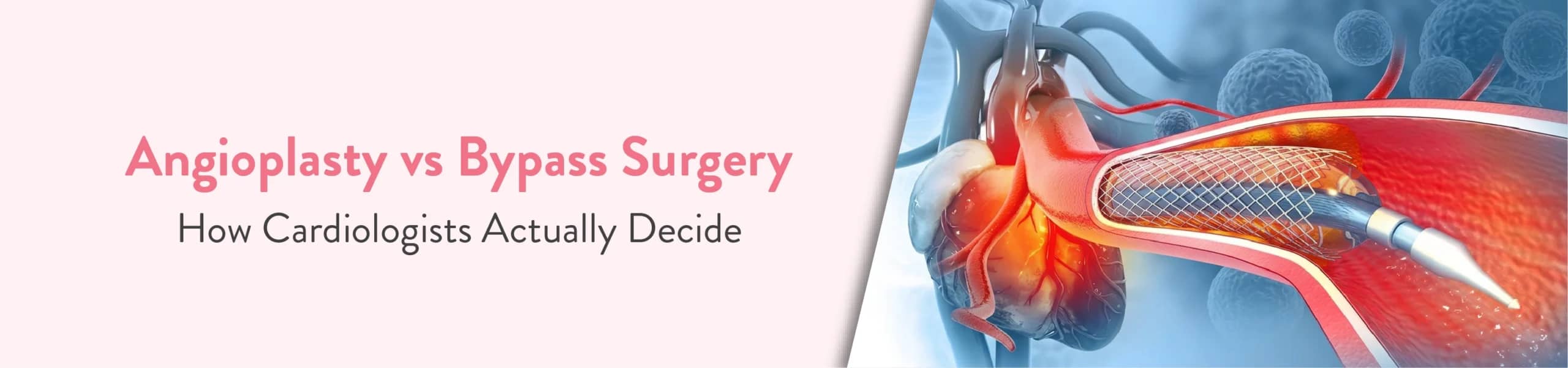
Understand the key differences between angioplasty and coronary artery bypass grafting (CABG).
Learn how each procedure treats blocked heart arteries and improves blood flow.
Explore recovery time, hospital stay and long-term outcomes after both procedures.
Discover how blockages, heart function, diabetes and other health conditions influence treatment decisions.
Find out how cardiologists help determine the most suitable treatment for your heart health.
Angioplasty and Coronary artery bypass grafting (CABG) both treat blocked heart arteries, but in different ways. Angioplasty opens the artery from the inside with a balloon and stent, while bypass surgery reroutes blood around the blockage using a graft. Which one you are offered depends on how your cardiologist reads your reports. In this blog, we will find out how the two compare, and what cardiologists look at before recommending one.
Before understanding the difference between angioplasty and bypass surgery, it helps to know when these procedures are needed in the first place.
When fatty deposits called plaque build up inside the arteries supplying blood to the heart, they can narrow the arteries and restrict blood flow. This condition is known as coronary artery disease (CAD).
Depending on the severity of the blockage, symptoms and your overall heart health, medicines and lifestyle changes are advised. If the blockages significantly affect blood flow, or the risk of heart-related complications is high, a cardiologist may recommend angioplasty or coronary artery bypass grafting (CABG) to improve blood supply to the heart.
Both improve blood flow to the heart muscle. The difference is how.
Angioplasty, also called percutaneous coronary intervention (PCI), is a minimally invasive procedure. It uses a thin tube called a catheter, inserted through an artery in the wrist or groin. A small balloon widens the narrowed section, and a stent, a tiny mesh tube usually coated with medicine, is left in place to help keep the artery open. The procedure is usually performed under local anaesthesia, and many patients go home the same day or the following day if there are no complications.
Coronary Artery Bypass Grafting (CABG), commonly called heart bypass surgery, is usually performed under general anaesthesia. In the standard approach, the surgeon opens the chest through the breastbone to reach the heart. A healthy blood vessel from the chest, leg or arm is then used to create a new route for blood to flow around a blocked coronary artery. The number of grafts depends on the location and extent of the blockages. The hospital stay is generally around 5 to 7 days, depending on recovery.
Neither procedure cures the underlying disease. The other arteries can still build plaque, which is why medicines and lifestyle changes are very important even after a procedure.
Angioplasty vs. Coronary Artery Bypass Grafting
| Angioplasty (PCI) | Heart Bypass Surgery (CABG) | |
| What it does | It widens the narrowed section of the artery using a balloon and stent to improve blood flow. | It creates a new route for blood around the blockage using a graft. |
| How it is done | Thin tube passed through the wrist or groin artery | Usually open-chest surgery; grafts taken from the chest wall, leg or forearm |
| Anaesthesia | Usually local, with sedation | General |
| Usually preferred for | Heart attack, one or two blockages, higher surgical risk | Left main disease, three-vessel disease, diabetes with multivessel disease, weak heart pump with multivessel disease |
| Hospital stay | Often 1 to 2 days | Around 5 to 7 days |
| Recovery | Days to a couple of weeks | Roughly 6 to 12 weeks |
Is robot-assisted heart surgery an option?
Advances in surgical technology mean some procedures can now be done through small incisions with robotic assistance. Whether it is suitable depends on the type of problem, your anatomy and your overall health, and it is usually offered at specialised centres. Your surgical team will explain which approach is right for you.
At the CK Birla Hospital, our dedicated Robotic Surgery Centre offers robotic-assisted surgery. The surgeon stays in full control and works through small incisions, using a magnified 3D view and instruments that reach difficult areas with greater precision.
Cardiologists consider several factors before recommending angioplasty or bypass surgery. These include:
In more complex cases, an interventional cardiologist and a cardiac surgeon may review the reports together before recommending a procedure. The goal is to choose a treatment that restores blood flow to the heart and offers the best possible long-term outcome for that patient.
If there are no complications, recovery is usually quick.
Recovery takes longer, mainly because the breastbone needs time to heal after surgery.
Cardiac rehabilitation helps in both cases. It is a supervised recovery programme in which a team of doctors,physiotherapists and dietitians helps you rebuild strength, guides you on diet and medicines, provides support for stress and anxiety, and helps you make heart-healthy changes to your routine.
Angioplasty and bypass surgery both restore blood flow to the heart, but the right one depends on how many arteries are affected, where the blockages sit and how your heart and body are doing overall. Our experienced cardiology team at the CK Birla Hospital can guide you to the treatment that suits you. To get an expert opinion, book a consultation.
Written and Verified by:

Similar Cardiology Blogs
Request a call back