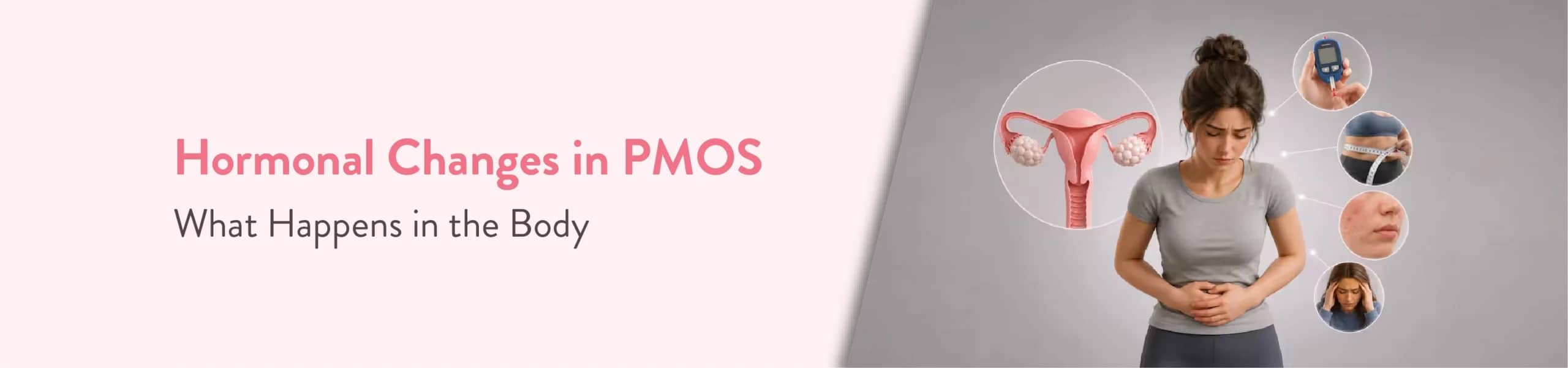
Has your period cycle become irregular lately? You may also be finding that weight is harder to manage, acne keeps returning, or hair is growing more on your face or body. On their own, these can seem like unrelated problems. Often, though, they share a common cause: the way your reproductive and metabolic hormones interact.
That interaction is central to Polyendocrine Metabolic Ovarian Syndrome (PMOS), formerly known as PCOS. Renamed in 2026 to reflect its effects beyond the ovaries, it affects about 1 in 8 women worldwide. So, what is really happening inside your body when you have PMOS? Let’s find out!
The main hormones and related systems involved include:
| Hormone or system | What can change in PMOS? |
| Insulin | The body may respond less effectively to insulin, leading to higher insulin levels in some people |
| Androgens | Levels or activity may be higher than expected, causing symptoms such as excess facial hair or acne |
| LH (Luteinizing hormone) | It is a (LH) is a vital reproductive hormone produced by the pituitary gland in the brain. Changes in reproductive hormone signalling can affect follicle development and ovulation. |
| FSH (Follicle-stimulating hormone) | Altered follicle development can contribute to irregular ovulation |
| Oestrogen | Its pattern may become less predictable when ovulation is irregular |
| Progesterone | A normal progesterone rise may not occur regularly if ovulation is absent |
Everyone experiences PMOS differently. One person may mainly have irregular periods, while another has more acne or hair growth. The international guideline calls this a ‘heterogeneous’ condition, which simply means it varies widely.
No single mechanism explains every case of PMOS. Usually, a few factors act together, and their influence differs from one person to the next.
Insulin resistance means the body’s cells do not respond to insulin as effectively as they should. Insulin is the hormone that helps glucose move from the blood into cells for energy.
When the body becomes less responsive to insulin, the pancreas may produce more insulin to compensate. This is called hyperinsulinaemia, meaning higher-than-usual insulin levels in the blood.
In PMOS, higher insulin levels can interact with the ovaries and increase androgen production. Insulin can also reduce the liver’s production of sex hormone-binding globulin (SHBG), a protein that normally binds some sex hormones in the bloodstream. Less SHBG can mean more free testosterone is available to act on tissues.
This is one reason the metabolic and reproductive sides of PMOS are closely connected.
Androgens are hormones involved in sexual development and reproductive function. Although they are often called ‘male hormones’, women naturally produce androgens too.
In PMOS, some people have hyperandrogenism, in which higher androgen levels or signs of increased androgen activity.
This may contribute to:
Ovulation is where many of these hormonal changes come together.
Normally, an egg containing follicle develops in the ovary and eventually releases an egg. This process is called ovulation. After ovulation, the body produces more progesterone.
When ovulation does not happen regularly, this normal hormonal process is disturbed. Progesterone may not rise in its usual pattern, and menstrual cycles can become irregular, infrequent or sometimes absent.
This helps explain why irregular periods are so common in PMOS.
It also explains an important misconception that irregular periods are not simply a problem with the uterus. They can reflect changes in the hormonal signals that control the ovaries and ovulation.
Oestrogen is another important reproductive hormone. It helps regulate the menstrual cycle and plays roles in the reproductive system, bones and other tissues.
It would be too simplistic to say that PMOS always causes high oestrogen or low oestrogen. When ovulation is irregular, the normal pattern of oestrogen and progesterone throughout the menstrual cycle can also change.
No. One person may mainly experience irregular periods and difficulty with ovulation. Another may have too much acne or excess facial hair. Someone else may have few visible hormonal symptoms but have metabolic risk factors that need attention.
This happens because PMOS is shaped by various factors that interact, including insulin, androgens, genetics and body composition, and the mix is different in each person. Two people can share the same diagnosis but have different symptoms and hormone patterns
A healthcare professional may look at:
Yes, but what works best depends on the symptoms that bother you most, your overall health, and whether you are planning to get pregnant right now.
Management of this condition usually draws on a few different things, such as lifestyle changes, medicines to regulate your periods or ease symptoms like acne and excess hair, treatment for any metabolic concerns, and fertility treatment if needed. Eating well and staying active are a core part of PMOS care, and they can help to improve your overall health.
If you are trying to conceive, the focus is often on helping your body ovulate. If you are not, the priority is usually bringing your cycle back into a steadier rhythm and managing symptoms like acne or hair growth.
Either way, the aim is not simply to balance your hormones, but it is to understand which changes are affecting you and build a plan that fits your health and your goals.
If your periods stay irregular, you are noticing new symptoms like acne or extra hair growth, or you are worried about your metabolic health, it is worth speaking to a specialist, ideally a gynaecologist. They can evaluate your overall health, which is far more reliable than trying to make sense of individual hormone results on your own.
At the CK Birla Hospital, the Department of Obstetrics and Gynaecology can help you assess hormonal and reproductive concerns linked to PMOS. Our multidisciplinary team works with you to build a care plan around your symptoms and your health needs.
Written and Verified by:

Similar Gynaecology Blogs
Request a call back


