Understand what Alzheimer’s disease is and how it affects brain cells and memory.
Recognise early symptoms, including repeated questions, confusion and difficulty with familiar tasks.
Explore the mild, moderate and severe stages of Alzheimer’s disease.
Learn about risk factors, diagnostic tests and available treatment options.
Discover practical lifestyle tips to support daily living and learn when to consult a neurologist.
Occasional forgetfulness is a normal part of ageing. Walking into a room and forgetting why, blanking on someone’s name, or misplacing spectacles are all common, and usually pass without any trouble. What deserves more thought is forgetfulness that becomes more frequent and starts to change how a person manages their day. It can be a sign of Alzheimer’’ disease.
Keep reading to learn what Alzheimer’s disease is, its early signs, how it is diagnosed, and how it can be managed.
Alzheimer’s is the most common cause of dementia, and the WHO estimates that more than 57 million people live with dementia worldwide.
The Alzheimer’s and Related Disorders Society of India (ARDSI) estimated that 5.3 million people aged over 60 were living with dementia in India in 2020. This figure was projected to rise to approximately 7.6 million by 2030.
Alzheimer’s is a neurodegenerative disorder, which means brain cells gradually stop working and die. It is the most common cause of dementia, the broader term for memory loss and thinking problems serious enough to affect daily life.
Two proteins are central to the damage.
Together they disrupt communication between cells, and the cells gradually lose their ability to function and eventually die.
The damage usually begins in the hippocampus, the part of the brain that forms new memories. This is why recent events, like a conversation from this morning or what was eaten at lunch, tend to fade first. Older memories are stored more widely in the brain and are often preserved for longer.
Many people assume memory loss is the only sign of Alzheimer’s. It is often the most visible one, but not the only one. Following are the other patterns to look for:
Forgetting a name and remembering it after a few hours is ordinary ageing. Forgetting the whole conversation, and not recalling it even when reminded, is what needs to be timely addressed.
One more thing worth knowing. Memory lapses are not always due to Alzheimer’s. Low vitamin B12, an underactive thyroid, depression, poor sleep and some medicines can look very similar, and some of these can be treated. This is one of the better reasons not to wait and see.
Neurologists usually describe three stages:
Treat these stages as a rough map. A person may show signs of more than one stage at a time. An infection or another health problem can also temporarily worsen confusion or other symptoms.
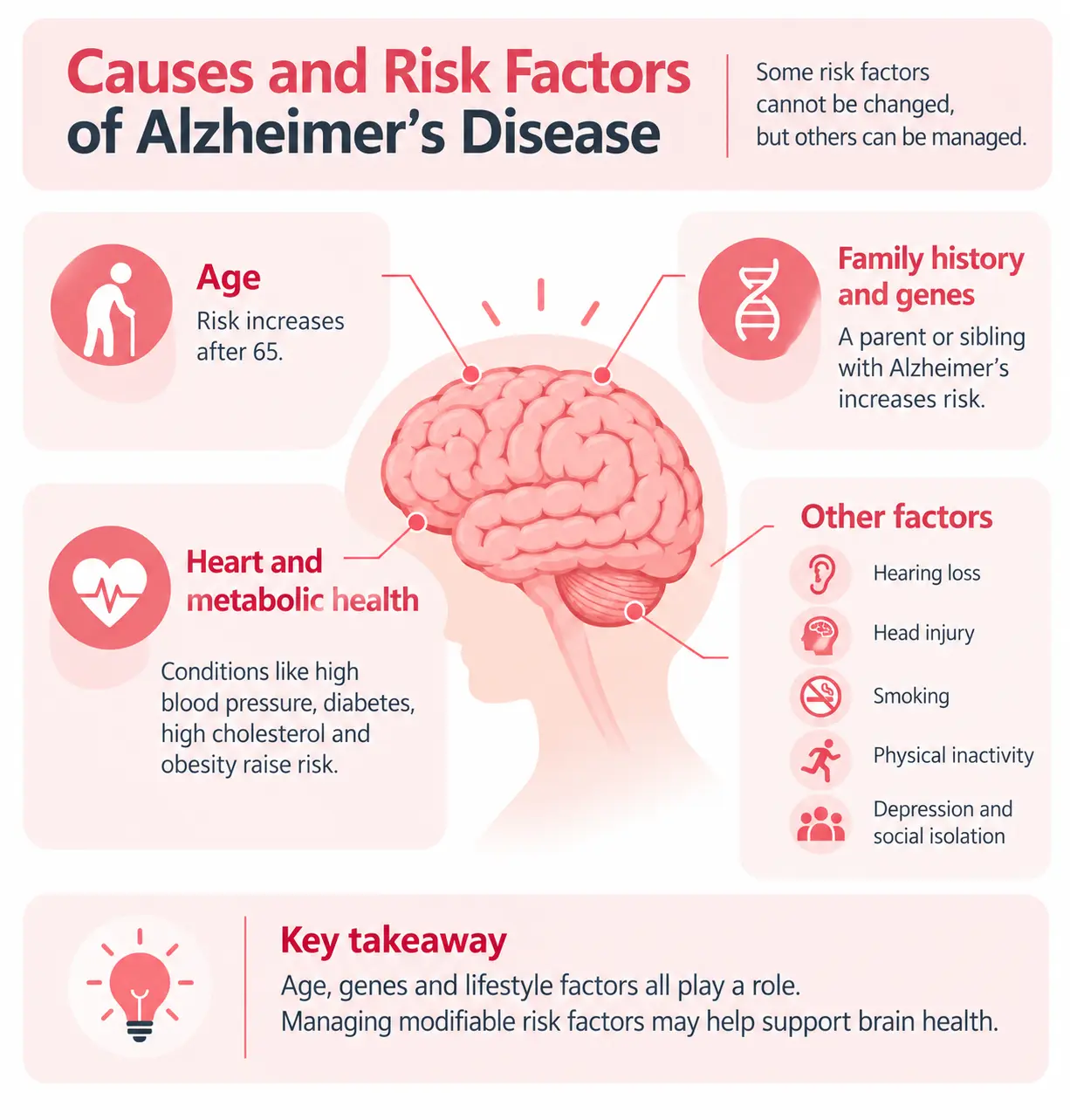
Changes linked to Alzheimer’s disease can begin in the brain 10 to 20 years before the first symptoms appear. Age, genes and lifestyle factors can all influence a person’s risk of developing the disease.
 What about early-onset Alzheimer’s?
Alzheimer’s that develops before age 65 is less common. Although some cases are caused by rare inherited genetic mutations, these account for an estimated 1% or less of all Alzheimer’s cases. Most people with early-onset Alzheimer’s do not have one of these rare, strongly inherited forms.
Diagnosis is usually handled by a neurologist, and it happens in stages rather than in one visit. A typical evaluation includes:
Common Mistake: Testing Memory at Home
A common mistake is to quiz the person at home with random questions, like “who is the Prime Minister?” or “what did you have for lunch?”, to see if they really remember. It tends to embarrass them and tells you very little. It is more useful to write down real examples of what you have noticed, so the doctor has something specific to work with during the evaluation.
Alzheimer’s cannot be cured at present, but that does not mean nothing can be done. Treatment focuses on easing symptoms, slowing decline where possible, and making daily life more manageable for the person and the family.
Your neurologist may suggest medicines that help nerve cells communicate with each other. These can ease symptoms for a period, mostly in the mild to moderate stages. They work differently for different people, and the benefit is usually modest.
Treatment also covers the problems that come with the disease, such as disturbed sleep, anxiety, low mood and agitation.
Most of the day to day difference happens at home.
If memory changes are getting in the way of daily life, book a visit with a neurologist and take along the family member who sees it most. An early check either finds a treatable cause or gives your family time to plan, so you are not making big decisions in a crisis.
At the CK Birla Hospital, our experienced team of neurologists can help you and your family manage this condition. Book a consultation to get your questions answered.
Written and Verified by:

Similar Neurology Blogs
Request a call back


