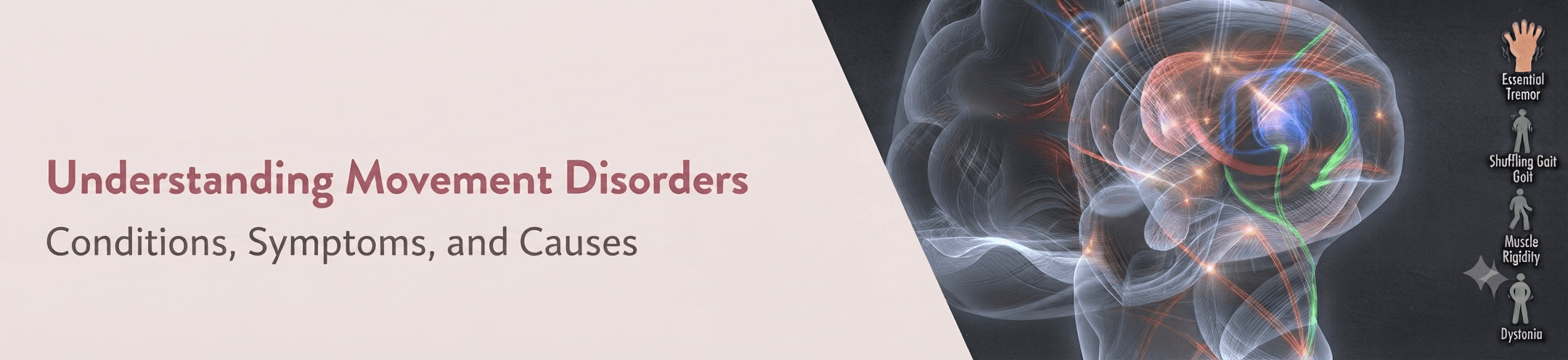
Movement disorders are neurological conditions that affect the brain's control over body movement, causing symptoms like tremors, stiffness, slowness or involuntary jerking. They're grouped into hypokinetic (too little movement, as in Parkinson's disease) and hyperkinetic (too much movement, as in tremor, dystonia or chorea) types, with treatment ranging from medication to therapy to procedures like Deep Brain Stimulation.
From lifting a cup to taking a step, our every movement depends on a finely coordinated nervous system. When that coordination is disrupted, the change can be surprisingly visible, sometimes starting with something as simple as a trembling hand.
That disruption is medically called a movement disorder, which is a group of neurological conditions where the brain’s control over the body’s motion does not work the way it should. Read along to know what causes it, what it looks like, and how to treat it.
Movement disorders are neurological conditions that affect the way a person moves and controls their body. In other words, these disorders affect the nervous system’s ability to control and coordinate body movements. This issue originates in the brain, specifically in the areas that plan, initiate, and coordinate motion, such as the basal ganglia and cerebellum.
Broadly, neurologists split these conditions into two categories:
According to the National Institute of Neurological Disorders and Stroke (NINDS), movement disorders can affect people at different ages, depending on the specific condition. Some, such as dystonia, can begin at any age, whereas others, including certain types of tremor, are more common in middle-aged and older adults. Some disorders are genetic, some develop after injury or illness, and for others, an exact cause cannot be pinned down.
Parkinsonism refers to a cluster of symptoms such as slowness of movement (bradykinesia), muscle stiffness, tremor at rest and balance problems that show up together. Parkinson’s disease is the most common cause of this disorder, but similar symptoms can arise from certain medications, repeated head trauma or other neurodegenerative conditions like progressive supranuclear palsy.
Tremor is an involuntary, rhythmic shaking of a body part. It generally affects the hands first, making everyday tasks like writing, buttoning a shirt, or drinking soup notably harder.
There is a common misconception where people assume any hand tremor means Parkinson’s. It usually doesn’t. Tremor tends to worsen with intentional movement (like reaching for something), while Parkinsonian tremor can also appear at rest and ease during activity.
It causes involuntary muscle contractions that lead to twisting movements or abnormal, sometimes painful postures. It can affect one part of the body like the neck in cervical dystonia or spread more widely. Some people with dystonia experience a phenomenon known as a “sensory trick”, where touching the affected area lightly (a hand to the chin, for instance) temporarily eases the spasm.
Chorea produces brief, irregular movements that seem to flow randomly from one part of the body to another. Huntington’s disease is the commonly known genetic cause, but chorea can also show up with certain autoimmune disorders, during pregnancy (called chorea gravidarum), or as a side effect of some medications.
Because the movements usually look smooth rather than jerky, family members sometimes mistake early chorea for simple restlessness or fidgeting instead of recognising it as a neurological symptom.
Ataxia refers to a loss of coordination that involves unsteady walking, clumsy hand movements, slurred speech. It usually stems from cerebellum dysfunction. It can result from genetic conditions, degenerative conditions, stroke, certain infections or vitamin deficiencies (particularly vitamin E or B12).
Ataxia is sometimes the first visible sign of an underlying nutritional deficiency, which means correcting the deficiency can improve symptoms. It is not true for most other movement disorders on this list.
Tic disorders involve sudden, repetitive movements or sounds that a person feels an urge to make, like blinking, throat-clearing, or shoulder shrugging. Tics are not random; they tend to be the same movement repeated over and over. Many people can briefly hold them back, though this builds up tension that needs to be released.
Tourette syndrome is the most well-known tic disorder, marked by both movement and vocal tics lasting more than a year. Tics start in childhood, can worsen with stress or excitement, and may fade on their own with age. Because kids can suppress tics for short periods, teachers or parents sometimes miss them at first or assume the child is just being fidgety or seeking attention.
This category includes:
Symptoms vary by condition, but common ones are:
Some conditions also bring non-motor symptoms such as:
In Parkinson’s disease specifically, a reduced sense of smell and sleep disturbances can precede visible motor symptoms by years, something even attentive patients rarely anticipate.
Causes fall into a few broad groups and often more than one factor is involved:
Diagnosis usually involves:
Treatment depends mainly on the specific diagnosis, but generally includes:
The goal of treatment is not to erase symptoms completely. It is mainly about helping you maintain your quality of life and independence for as long as possible. Just knowing this tends to ease a lot of the anxiety patients feel after a diagnosis. Also, every movement disorder is different and treatment plans need to be personalised to the individual. It is always best to consult a neurologist for proper diagnosis and an individualised treatment approach.
It is worth having a proper conversation with a neurologist if you notice a tremor that interferes with daily tasks, frequent stiffness or slowness that is getting worse, sudden jerking or twisting movements, changes in handwriting or gait, or tics that persist beyond a few weeks.
Getting evaluated early can help you avoid more serious problems down the line. If you are noticing symptoms of a movement disorder, don’t wait it out. Book an appointment with a neurologist at the CK Birla Hospital today, and take the first step toward a clearer diagnosis and the right treatment plan for you.
Written and Verified by:

Similar Neurology Blogs
Request a call back