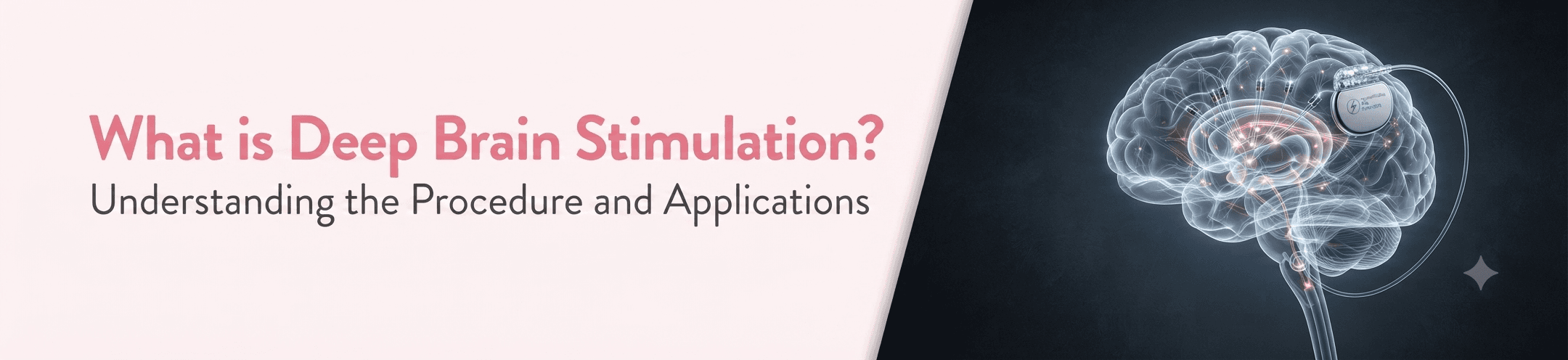
Deep Brain Stimulation (DBS) is a neurosurgical procedure that uses a pacemaker-like device to send mild electrical pulses to specific areas of the brain, helping control abnormal signals that cause movement and neurological disorders.
Movement disorders like Parkinson’s disease affect more than 8.5 million people worldwide. Many will eventually reach a point where medication no longer provides enough relief. For them, Deep Brain Stimulation (DBS) offers a different path. Its impact can be striking, patients who once struggled with basic tasks like eating or writing often regain a level of control they had not felt in years.
Curious how DBS actually works, who qualifies for it, and what the procedure and recovery really involve? Let’s break it down.
Your brain holds the main control of your body. It sends electrical signals to tell your body how to move, react, and function. But in certain conditions, some of these signals become disrupted, causing tremors, stiffness or movements you can’t control.
Deep Brain Stimulation (DBS) works by gently correcting these faulty signals. Thin wires, called electrodes, are placed in specific areas of the brain where the problem starts. These electrodes connect to a small device called a neurostimulator, similar to a pacemaker, usually placed under the skin near the collarbone.
Once activated, the neurostimulator sends mild electrical pulses to the targeted brain area. These pulses help calm the abnormal signals, easing symptoms that medication alone could not fully control.
The DBS system has three main parts:
DBS does not remove or destroy the affected part of the brain. It also does not stop the underlying progression of conditions such as Parkinson’s disease. Instead, it is designed to help manage symptoms.
Patient selection is one of the most important parts of DBS treatment.
It is an established treatment for movement disorders such as Parkinson’s disease, essential tremor and dystonia. In some cases, it may also be used for conditions such as epilepsy, Tourette syndrome and obsessive-compulsive disorder, though this depends on the specific case and relevant medical approvals.
For Parkinson’s disease, DBS may be considered when simply medication can no longer keep symptoms under control. In fact, NICE recommends considering deep brain stimulation (DBS) for people with advanced Parkinson’s disease whose symptoms are not adequately controlled with best medical therapy.
A specialist assessment by a neurosurgeon and movement disorder neurologist may consider:
A 2026 expert consensus from the Parkinson’s Research Alliance India also highlights the importance of careful patient selection for DBS, ensuring psychiatric stability, precisely identifying the right brain target, and involving a multidisciplinary team throughout the assessment process.
The potential benefit of DBS depends on the condition being treated, the symptoms present and how carefully the patient is selected.
For appropriate patients, DBS may:
DBS is generally considered safe when performed in carefully selected patients by an experienced, functional neurosurgeon. Serious complications are uncommon, and several precautions are taken to minimise risks.
Potential risks include:
DBS does not end with implantation. The neurology specialists may need several followup appointments to check the device and achieve the best balance between symptom control and side effects.
DBS treatment begins with careful planning before moving on to the actual implantation of the stimulation system. The exact approach can vary from patient to patient, depending on their condition, brain anatomy, surgical plan, and the specific protocols followed by the hospital.
Before surgery, the patient undergoes a detailed neurological evaluation. Brain imaging, such as MRI or CT, may be used to map the brain and identify the precise target for electrode placement. Cognitive and psychological assessments may also form part of the evaluation.
The neurosurgeon uses specialised imaging and stereotactic (3D coordinate system) techniques, which means highly precise methods for locating a specific point inside the brain, to guide the electrodes into the selected target.
In some cases, the patient may remain awake during part of this stage so the team can assess symptoms and responses during electrode placement. In other situations, DBS can be performed using general anaesthesia. The approach is individualised rather than one method being suitable for everyone.
The neurostimulator is placed beneath the skin, usually in the upper chest near the collarbone. Extension wires under the skin connect it to the electrodes in the brain.
The device is generally activated after the initial surgical recovery period. A neurologist or trained DBS specialist then adjusts the stimulation settings according to the patient’s symptoms and response.
This is an important part of treatment. The best settings are not necessarily found during the first programming session. Mayo Clinic notes that optimisation can take several months in some patients.
Recovery has two parts:
During the first few days, patients may experience tiredness, discomfort or swelling around the surgical areas. Before you head home, the healthcare team walks you through everything you need to know, how to care for the incision, which medicines to take, and how much physical activity is safe during recovery.
Over the following weeks, the surgical wounds continue to heal and followup appointments are scheduled. The neurostimulator may then be activated and programmed according to the treatment plan.
It is important to know that your symptoms do not always improve immediately or completely right away. The care team gradually adjusts the stimulation settings over time, based on how symptoms respond and whether any side effects show up along the way.
You should follow your neurosurgical team’s guidance on when to return to work, resume physical work and get back to other daily activities.
For many patients with certain neurological conditions, treatment like DBS can turn symptoms that once felt unmanageable into something livable again. If you would like to know more about this treatment approach or need guidance on managing a neurological condition, start by talking to our neurologist or neurosurgeon. At the CK Birla Hospital, our Neurosciences team is here to guide you through a personalised assessment and walk alongside you at every step. Simply reach out to us to book a consultation!
Written and Verified by:
Similar Neurosurgery Blogs
Request a call back