It is normal to get a headache once in a while after a long, tiring day. You rest, drink some water and move on. But sometimes the pain sticks around, throbs on one side of your head, or comes with sensitivity to light and sound. That is usually a sign it is not a regular headache. It could be a migraine.
The two are often confused, but they are different conditions with different causes and treatments. Here’s how to spot the difference between migraines and other common headaches, and when it is worth seeing a doctor.
Let’s look at some major differences between a migraine and a normal headache.
| Feature | Normal Headache | Migraine |
|---|---|---|
| Area of pain | Can affect both sides of the head or feel spread across the head | Often affects one side of the head, but can occur on both sides |
| Type of pain | Usually feels like pressure, tightness or a dull ache | Throbbing or pulsating |
| Pain intensity | Usually mild to moderate | Moderate to severe |
| Duration | Can last from a few hours to a day | Can last 4 to 72 hours if untreated |
| Nausea or vomiting | Less common | Common, and vomiting can occur |
| Sensitivity to light or sound | Less common | Common |
| Physical activity | Usually does not significantly worsen the pain | Routine physical activity can make the pain worse |
| Aura | Not common | Some people experience aura, such as flashing lights, blind spots, tingling or difficulty speaking, before or during an attack |
| Triggers | Can be linked to stress, tiredness, dehydration, poor posture or lack of sleep | Can be triggered by hormonal changes, stress, lack of sleep, certain foods, dehydration, bright light and other individual triggers |
| Related symptoms | Usually limited to head pain | May include nausea, vomiting, light/sound sensitivity, visual symptoms and other neurological symptoms |
| Recurring pattern | May occur occasionally depending on the cause | Usually follows a recurring pattern, with attacks that can vary in frequency and severity |
Everyone can experience migraine differently. The pain may be:
As mentioned earlier, a person with migraine may also suffer with nausea, vomiting, sensitivity to light, sound or smells, dizziness, neck discomfort or difficulty concentrating.
Some people develop allodynia, where everyday sensations, such as brushing your hair or lightly touching your skin, can actually feel painful. It is a migraine symptom that is easy to overlook.
It is not necessary for everyone with migraine to experience all four phases.
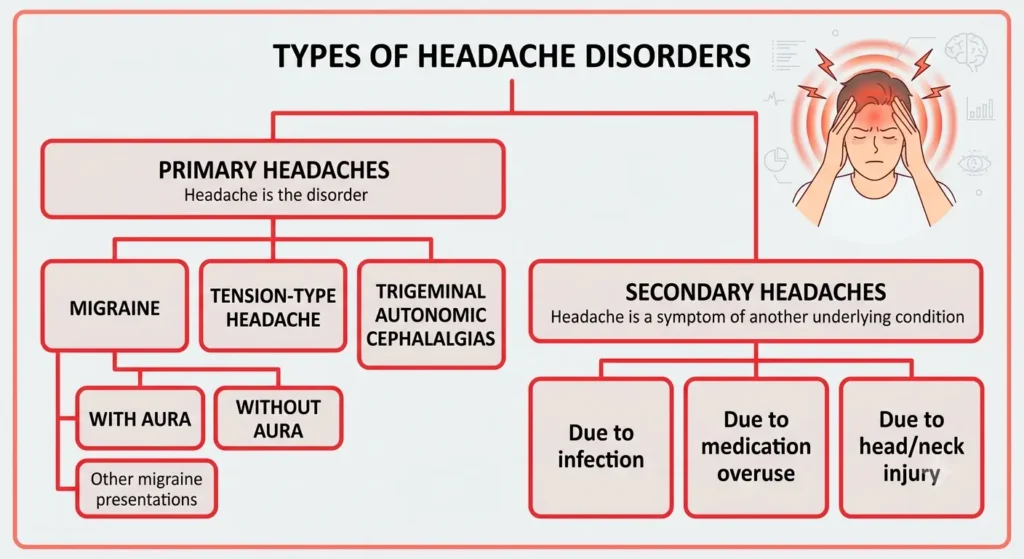
Migraine symptoms can vary from one person to another. Here are some of the common types you should know about.
Migraine usually does not require a specific blood test or brain scan for diagnosis. To confirm the condition, migraine treatment doctors (neurologists) look at the overall pattern.
A neurologist will ask about the nature, duration and frequency of your headaches, related symptoms, medical history and family history. A physical and neurological examination may also be performed.
Imaging such as an MRI or CT scan may be recommended in some situations when the doctor needs to look for another possible cause.
Important Tip:Keeping a headache diary can be useful. Record when the headache starts, how long it lasts, where the pain occurs, symptoms, possible triggers, menstrual timing if relevant, medicines taken and how the headache responds. Noting down these patterns can help during the consultation.
Getting a headache occasionally is common. But when headaches keep coming back or begin to affect your work, sleep, studies, exercise or everyday routine, it is worth talking to a neurologist.
Get yourself evaluated if:
If you suddenly get a severe headache unlike anything you have felt before, especially along with weakness, numbness, trouble speaking, confusion, blurred or lost vision, a stiff neck with fever, or fainting, don’t wait it out. These can be signs of a secondary headache, where something else in the body is causing it, and it needs to be checked out right away.
Most occasional headaches are not serious, and rest, water, or a painkiller usually works. But if they keep coming back, feel different from usual, or start interfering with your day-to-day life, you should get it checked instead of just pushing through.
The Neurology and Neurosciences Department at the CK Birla Hospital can help figure out what’s causing your headaches and the right way to manage them. You can simply book a consultation to get a better understanding of your headaches and the next steps in care.
Written and Verified by:

Similar Neurology Blogs
Request a call back