Understand what happens during an ischaemic or haemorrhagic stroke.
Recognise early stroke warning signs using the BE FAST approach.
Learn why the Golden Hour matters and how timely treatment can reduce brain damage.
Know the immediate steps to take when someone shows signs of a stroke.
Understand common stroke myths, emergency treatments and recovery options.
We are hardly prepared for uncertain events in our lives. At the moment most of us are too confused to react correctly. For such scenarios it is essential to have regular awareness. Yes we do not want uncertain events, but it always helps to be prepared for them. One such incident is a stroke.
Imagine sitting with your family when someone suddenly struggles to speak. Their smile looks uneven, or one arm starts losing strength. They insist they are fine, but something clearly isn’t right.
What would you do? – give them water? ask them to rest? find a home remedy? Or rush them to the hospital? – For many families, these first few decisions can be overwhelming. Unfortunately, this is also when valuable time can be lost. To know what to do in such circumstances, we need to understand stroke better.
A stroke doesn’t always look dramatic. Sometimes, it begins with something as simple as slurred speech, sudden dizziness or difficulty holding a cup. But here’s what everyone needs to know:
The brain is essentially shutting down in phases and each phase surfaces as a symptom on the patient. Understanding the warning signs, knowing what to do and reaching the right hospital in time can make a significant difference.
Our brain needs a continuous supply of oxygen-rich blood to function. When this blood supply is interrupted, brain cells begin to get damaged. This is what happens inside the brain during the onset of a stroke. The cause decides what kind of stroke is getting triggered.
Both types of strokes affect the brain, however their treatments are very different. Doctors often need an urgent CT or MRI scan to identify the type of stroke before deciding on the appropriate treatment. And for this precise reason treating a stroke at home is dangerous. Because during a stroke, what appears to be the same set of symptoms, often requires completely different medical interventions.
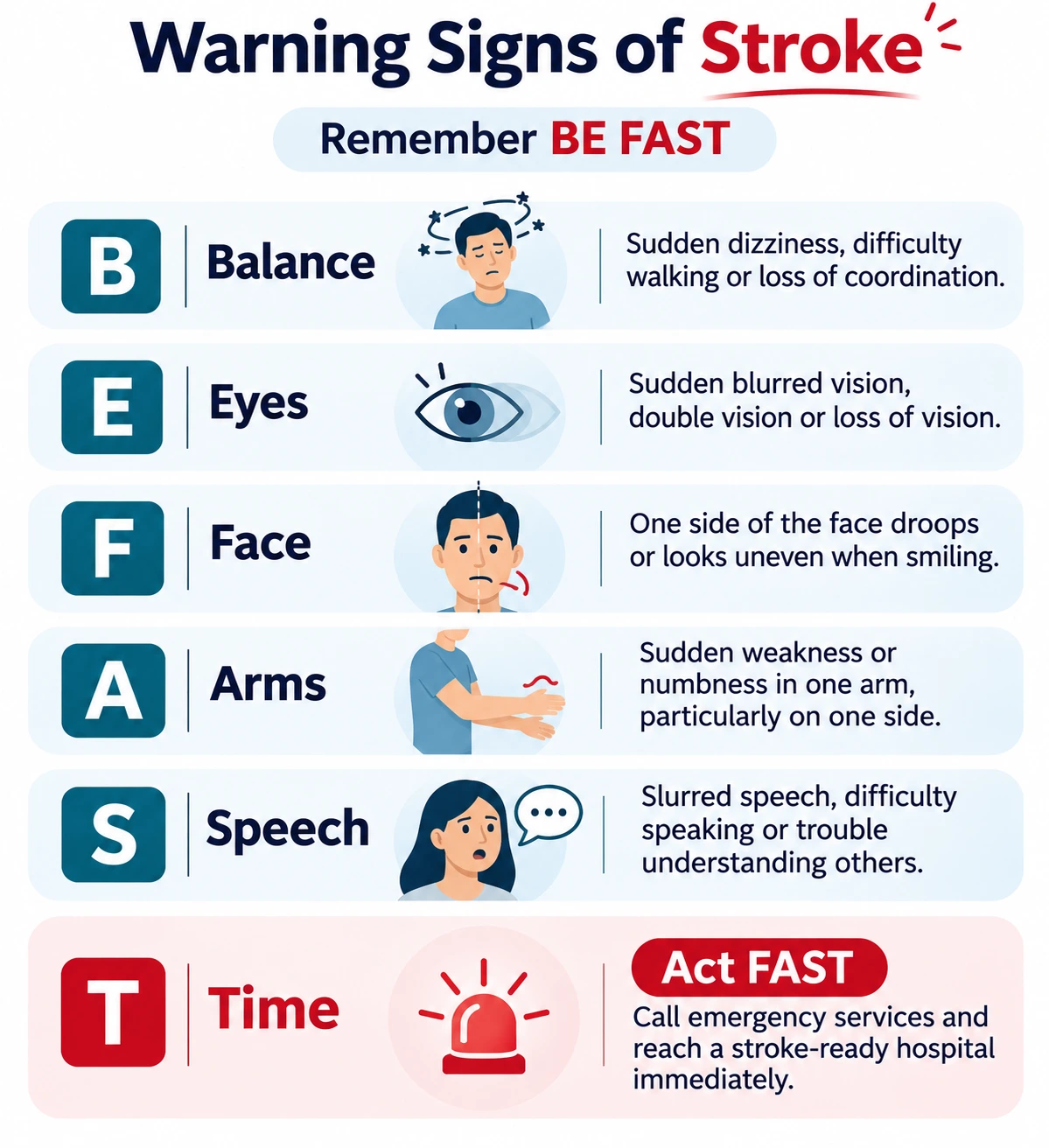
One of the biggest challenges with stroke is recognising it early. Symptoms tend to appear suddenly, and people most often mistake them for tiredness, weakness or low blood pressure.
An easy way to remember the warning signs is BE FAST. Other symptoms may include a sudden, severe headache, confusion or difficulty swallowing.
Remember, a person does not need to experience all these symptoms to be having a stroke. Even one sudden warning sign deserves immediate medical attention.
You may have heard doctors talk about the Golden Hour in stroke care. But what does it actually mean? The Golden Hour refers to the critical early period after stroke symptoms begin, particularly the first 60 minutes. It highlights the importance of getting medical attention as quickly as possible.
Why is this so important?
During an ischaemic stroke, the blood supply to a part of the brain is blocked. Without oxygen, brain cells begin to get damaged. The longer the blockage remains untreated, the greater the potential for permanent damage.
Time is brain. Early treatment may help restore blood flow, preserve brain tissue and improve the chances of recovery. For eligible patients with an ischaemic stroke:
These are treatment windows, not reasons to wait. Some patients may also qualify for treatment beyond conventional windows following specialised brain imaging and clinical assessment.
Note:Never assume it is too late to seek help. The Golden Hour gives the patient a chance to recover better. It is however not a strict cut-off after which treatment becomes impossible. So even if several hours have passed, reaching a hospital as soon as possible is essential because treatment may still be possible.
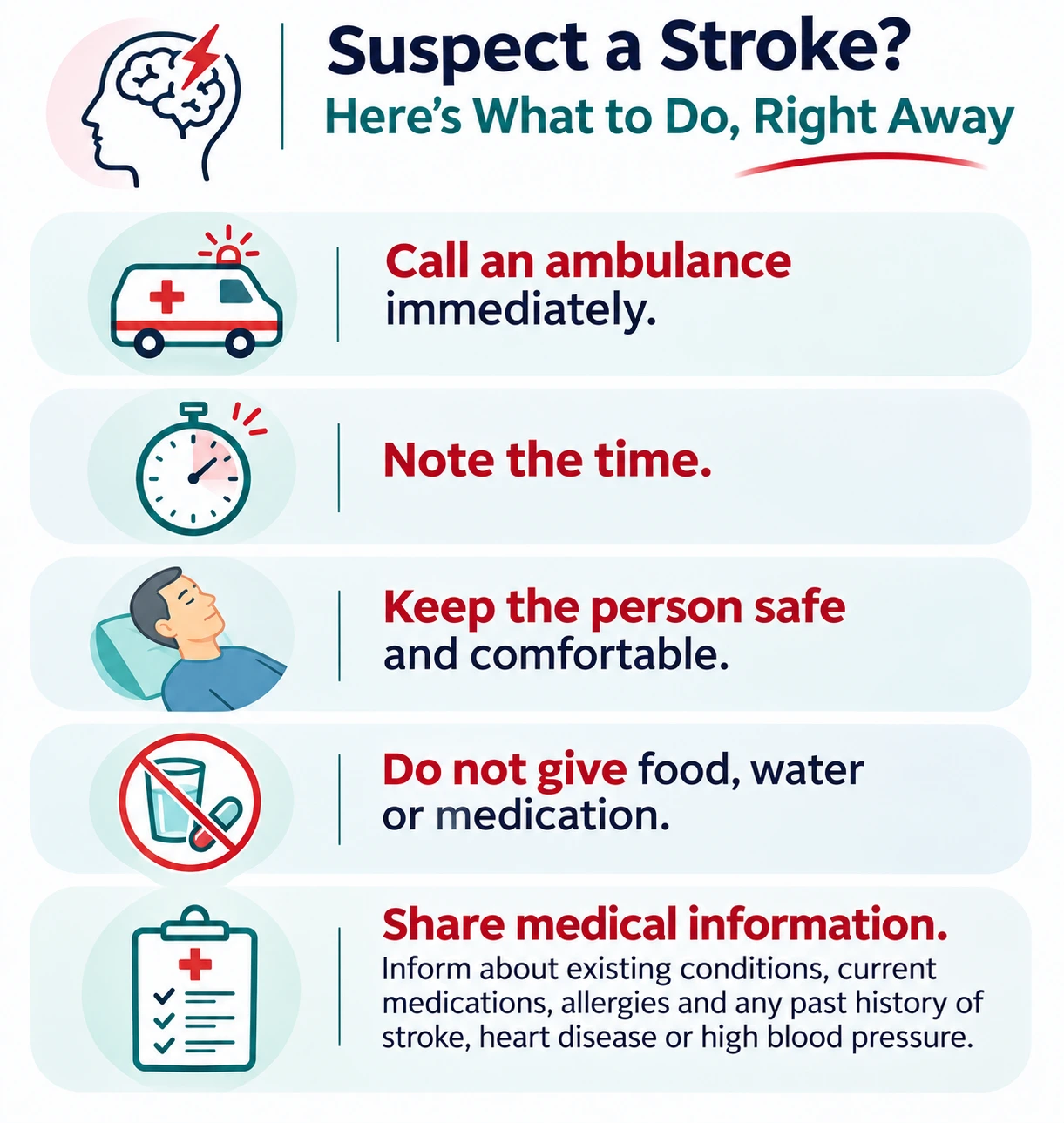
When someone develops stroke symptoms, it is natural to panic. But knowing a few simple steps can help you respond more effectively. Here is how a primary caregiver/ family member/ next to kin should respond:
Whatever you do, do not delay hospital transfer while trying to manage symptoms yourself.
| Myths | Facts |
| Myth 1: Stroke can be treated with home remedies. | Fact: No. A blood clot cannot be removed at home which can stop bleeding in the brain. Immediate hospital assessment is a must. |
| Myth 2: Give aspirin immediately. | Fact: Aspirin can worsen bleeding in a haemorrhagic stroke and should only be administered by a medical professional. |
| Myth 3: Massage the affected arm or leg to restore circulation. | Fact: Massage, acupuncture and pricking fingers cannot reverse a stroke. It simply delays the medical attention. |
| Myth 4: If symptoms disappear, there is nothing to worry about. | Fact: Temporary stroke-like symptoms may indicate a transient ischaemic attack (TIA). Even if the person starts feeling normal again, immediate medical evaluation is necessary. |
| Myth 5: Stroke only happens to older people. | Fact: No. Stroke can affect anyone with existing comorbidities like pressure, diabetes, smoking and certain heart conditions. |
The first priority is to identify the type of stroke and assess the extent of brain injury. Neurologists may conduct a neurological examination, check blood glucose and perform an urgent CT or MRI scan.
Depending on the findings, treatment may include the following:
| Thrombolysis: Medication that helps dissolve a blood clot in eligible patients with ischaemic stroke. | Mechanical thrombectomy: A minimally invasive procedure to remove a clot from a blocked brain artery. |
| Haemorrhage management: Treatment to control bleeding, manage blood pressure and reduce complications. | Neurosurgery: Certain patients may require surgery to relieve pressure on the brain or manage bleeding. |
Once the patient’s condition stabilises, rehabilitation is started in the form of physiotherapy, speech therapy and occupational therapy. This helps patients regain movement, communication skills and overall independence.
But do remember, recovery looks different for everyone, which is why treatment and rehabilitation need to be tailored to the individual.
Not every stroke can be prevented, but discipline and lifestyle can significantly reduce the risk. Here are a few non negotiables, if there has been a family history of stroke:
Regular health check-ups can help identify risk factors before they lead to complications.
A stroke can change someone’s life in minutes. Yet, one of the biggest challenges in stroke management is the delay between recognising symptoms and reaching medical care.
Don’t ignore symptoms under minor inconvenience, don’t give home remedies, don’t wait for symptoms to disappear, and finally don’t assume treatment is not possible after the Golden Hour. Because when it comes to stroke, timely treatment can make all the difference between lasting disability and a better chance at recovery.
Written and Verified by:

Similar Neurology Blogs
Request a call back


