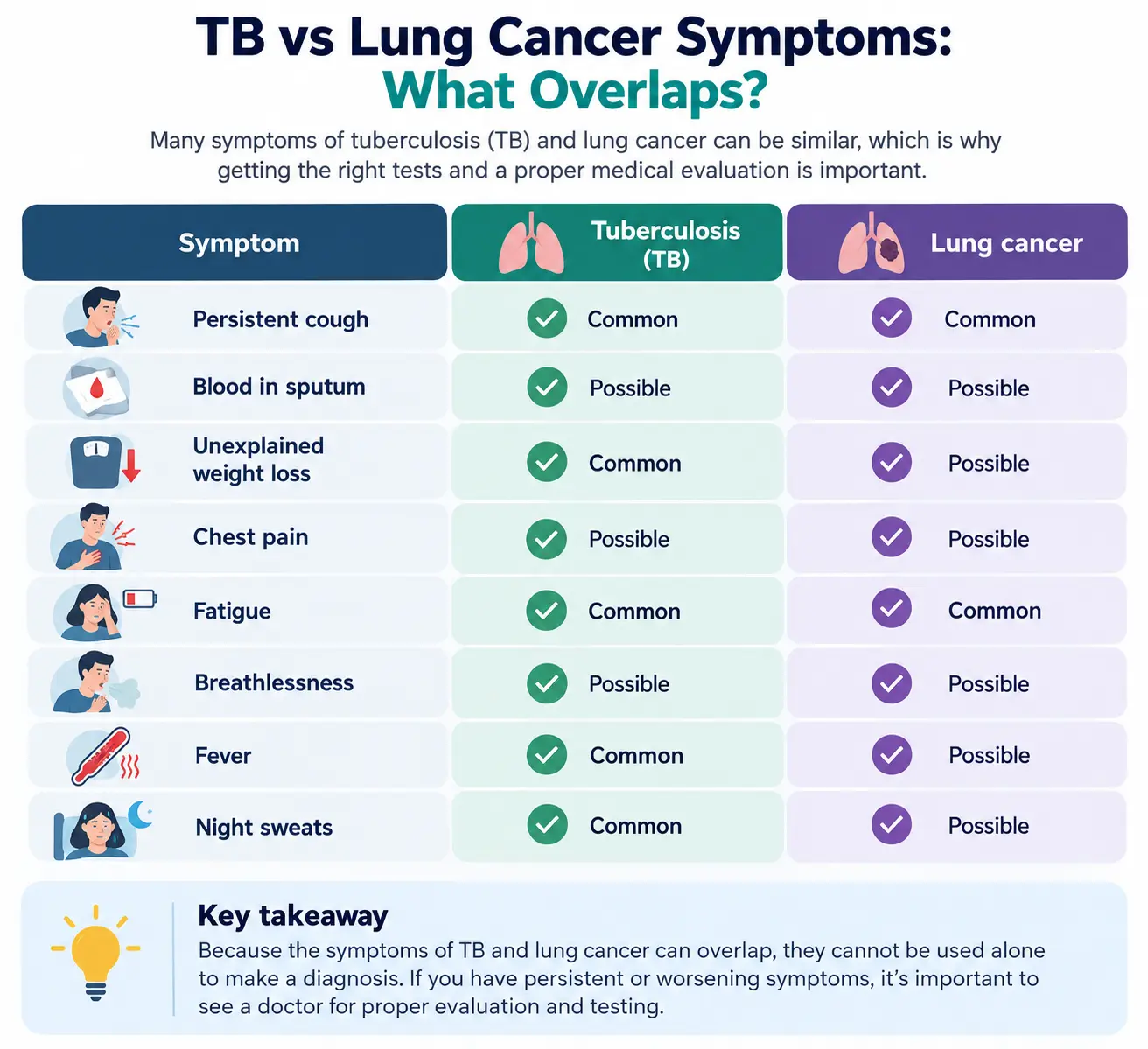
A persistent cough, unexplained weight loss, chest pain or blood in the sputum can be unsettling. What makes these symptoms particularly confusing is that they can occur in both tuberculosis (TB) and lung cancer. So, can TB and lung cancer look alike? Yes.
There is a strong overlap of symptoms and this may even look similar in imaging as well. Therefore a more careful assessment is warranted in such cases.
Tuberculosis is an infectious disease caused by Mycobacterium tuberculosis. It primarily affects the lungs and can cause inflammation, tissue damage, nodules, cavities and lymph-node changes.
Lung cancer, on the other hand, develops when abnormal lung cells grow uncontrollably and form a malignant tumour.
However, none of these symptoms can diagnose either condition on their own.
Yes. It can. TB can sometimes produce a lung nodule, mass-like lesion, cavity or enlarged lymph nodes that resemble malignancy on imaging. A specific form called a tuberculoma can appear as a well-defined pulmonary nodule and may be difficult to distinguish from a tumour based on imaging alone.
CT scans can provide much more information than a conventional chest X-ray, but even CT findings can overlap. For example, both TB and lung cancer may show:
It is notable that TB can mimic malignant disease on imaging and that definitive diagnosis may require microbiological or pathological confirmation.
In India TB is more common, therefore a lung lesion may initially be suspected to be tuberculosis, when accompanied with symptoms like cough, weight loss or fever. This complicates when underlying cancer is not considered when symptoms or imaging abnormalities persist.
Patients with lung cancer have sometimes initially been treated for TB because the two conditions share symptoms and radiological features. That does not mean every patient whose X-ray resembles TB has cancer. It means that persistent or unexplained abnormalities deserve appropriate follow-up rather than assumptions based on appearance alone.
When TB and lung cancer have similar symptoms or appear alike on a scan, doctors usually don’t rely on a single test to tell them apart. Instead, they look at the whole picture. Your symptoms, medical history, scan findings and, when needed, laboratory or tissue tests.
The aim is to understand what is actually causing the changes in the lungs rather than making a diagnosis based on appearance alone.
CT imaging is an important part of evaluating suspicious lung findings. Some patterns can provide useful clues.
But there is considerable overlap. A study comparing patients with TB alone and those with TB plus lung cancer found differences in features such as spiculation, lobulation and cavitation, while also demonstrating the diagnostic challenge of distinguishing the conditions.
Most importantly, a CT scan can identify a suspicious lesion, but imaging does not always establish whether that lesion is cancer or TB.
Even PET-CT has limitations. Active TB and other inflammatory conditions can show increased metabolic activity, potentially producing a “hot” lesion that resembles cancer.
Yes. A person can have tuberculosis and lung cancer at the same time. Pulmonary TB can be further complicated by lung cancer, and studies have found overlapping clinical and CT features between patients with TB alone and those with both conditions. This is clinically important because finding evidence of TB does not automatically rule out another lung condition.
TB does not simply transform into lung cancer. Tuberculosis is an infection, whereas lung cancer involves malignant changes in cells.
However, researchers have found a common link between the two in the form of Chronic inflammation, tissue injury and scarring. But an association between two conditions should not be interpreted as proof that TB directly causes cancer.
Therefore, TB can mimic lung cancer, lung cancer can mimic TB, and both can coexist, but TB should not be described as directly transforming into lung cancer.
If someone has been diagnosed with TB but symptoms persist, worsen or fail to follow the expected course despite appropriate treatment, the diagnosis and treatment response may need to be reassessed.
Persistent symptoms do not automatically mean cancer. Treatment adherence, drug resistance, another infection, residual lung damage and other respiratory conditions can also explain ongoing symptoms.
However, an unresolved lung lesion or persistent symptoms may warrant further evaluation. A history of TB should therefore not prevent doctors from investigating a new or changing lung abnormality.
Speak with a qualified pulmonologist or physician if you have a persistent cough, coughing up blood, unexplained weight loss, ongoing chest pain, breathlessness, recurrent chest infections or an abnormal chest X-ray or CT scan.
The important message is not to self-diagnose based on symptoms or scan images found online. TB and lung cancer can overlap, but they require very different treatments. The right diagnosis comes from putting symptoms, medical history, imaging and appropriate laboratory or tissue testing together.
TB and lung cancer are different diseases, but they can look remarkably similar. Their symptoms may overlap, imaging can sometimes be difficult to interpret, and both conditions can occasionally occur together.
The diagnosis should be established through appropriate clinical evaluation, imaging and, when necessary, microbiological testing or biopsy.
When a lung abnormality does not fit the expected clinical picture or fails to respond as expected, it deserves a closer look.
Written and Verified by:

Similar Pulmonology Blogs
Request a call back