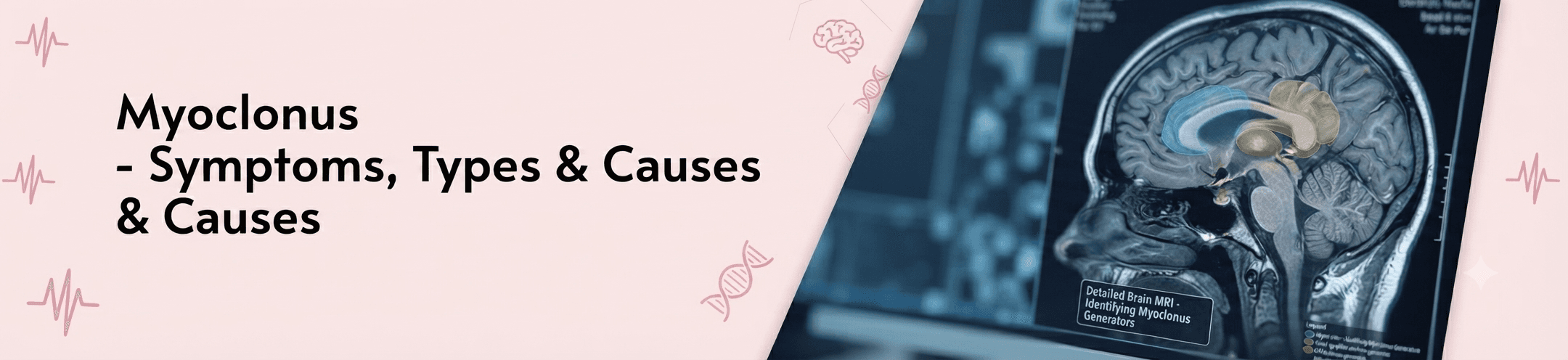
Myoclonus is a sudden, brief, involuntary jerking or twitching of a muscle or group of muscles, lasting a fraction of a second. It can be harmless (like sleep starts or hiccups) or linked to epilepsy, Parkinson's disease, stroke, or metabolic issues. Treatment depends on the underlying cause and may include medication or BOTOX.
Ever felt a sudden jerk or jump-like sensation just as you were drifting off to sleep? That brief, involuntary movement is called myoclonus. Most people experience it occasionally, especially while falling asleep and it is usually nothing to worry about. But myoclonus can also be linked to epilepsy, other neurological conditions, certain medicines, or metabolic problems.
Myoclonus is not a disease in itself. It is a way of describing a specific type of movement. That is why figuring out what is causing it is such an important part of diagnosis and treatment.
Myoclonus is a sudden, brief, involuntary jerking or twitching of a muscle or group of muscles. The movement usually lasts only a fraction of a second, although it can be felt repeatedly.
Most myoclonus results from a sudden muscle contraction, known as positive myoclonus. Less commonly, it occurs because an already going muscle contraction suddenly stops. This is called negative myoclonus.
For example, a person with negative myoclonus may briefly lose muscle control when holding a cup and drop it.
The movement can be experienced at rest, during an action, while maintaining a posture or in response to a stimulus such as a sudden sound or touch. When and how it happens can offer doctors important hints about what is causing it.
The main symptom is a sudden, brief muscle jerk that a person cannot voluntarily control.
Depending on its type and severity, myoclonus may cause:
Some people experience an isolated jerk from time to time, whereas others may have frequent movements that interfere with everyday activities.
Neurologists may classify myoclonus according to why it occurs, where it starts in the nervous system or when it happens.
This is common in otherwise healthy people and usually does not need any treatment. For example:
So, not every muscle jerk means there is an underlying neurological disorder.
Here, myoclonus occurs on its own without another identifiable neurological disorder causing it. It is usually stable or progresses very slowly. Some forms may run in families.
Myoclonic jerks can also be experienced as part of epilepsy, a neurological condition that causes seizures. One example is juvenile myoclonic epilepsy, which commonly begins around adolescence and may cause brief jerks involving the shoulders, arms or neck.
A myoclonic jerk does not confirm that a person has epilepsy. However, the pattern and, when appropriate, tests such as an EEG help neurologists determine whether the movements are seizure-related.
This type is usually experienced because of another condition or external factor. It can be associated with neurological diseases, metabolic problems, infections, brain injury, stroke, certain medicines and toxins.
Myoclonus results from abnormal electrical signalling in the nervous system’s movement pathways.
Some possible causes of myoclonus are:
A medication review is particularly useful because some medicines can cause myoclonus. If jerking begins after starting or changing a medicine, tell your doctor.
Diagnosis begins with a detailed medical history and neurological examination. The neurologist may ask:
The evaluation may include:
The investigations are selected according to the movement pattern and suspected underlying cause.
Treatment depends largely on what is causing the myoclonus. When an underlying condition, medicine or metabolic problem can be identified, addressing that cause is usually the first step.
Neurologists or movement disorder specialists may prescribe medicines that reduce abnormal nervous system activity.
For selected focal or segmental forms, botulinum toxin injections (BOTOX) can reduce excessive activity in specific muscles. This approach is particularly useful when jerking is limited to a small, well-defined group of muscles.
If myoclonus results from an electrolyte imbalance, kidney or liver problem, infection, medication or another neurological condition, treating that problem may reduce the jerking.
In some complex cases, other approaches such as immunotherapy, surgery or deep brain stimulation (DBS) may be considered depending on the underlying diagnosis.
You should consider consulting a neurologist if:
A movement disorder specialist or neurologist can determine whether the movements represent myoclonus and investigate the underlying cause.
If sudden jerking movements are becoming frequent or affecting your daily life, an evaluation with a specialist can help identify whether they are harmless or related to an underlying condition. The Neurology and Neurosciences Department at the CK Birla Hospital can help evaluate movement disorders such as myoclonus and determine an appropriate diagnostic and treatment approach. Simply book a consultation to get expert guidance.
Written and Verified by:

Similar Neurology Blogs
Request a call back