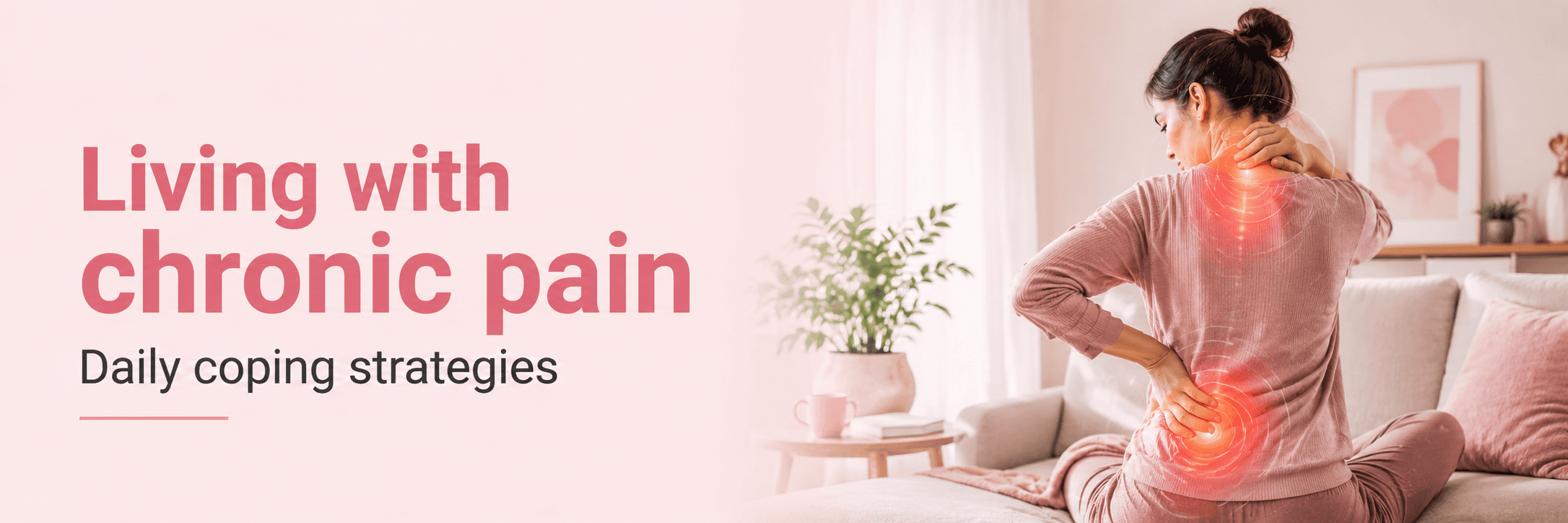
Most advice about chronic pain is written for the bad days. The days when you cannot get out of bed, when the pain is loud enough to block everything else out. That advice matters, but it is not the whole picture. Chronic pain is also the medium days, the managed days, the ones when you make it to work and cook dinner and still go to sleep exhausted. It is the background against which ordinary life has to happen.
Coping with chronic pain on a daily basis is less about surviving the worst days and more about building habits that reduce how much the pain takes over the ordinary ones.
Coping starts with paying attention, not anxious monitoring, but pattern recognition. Chronic pain is rarely constant and uniform. It flares and subsides. It is worse at certain times of day, triggered by certain activities, and affected by sleep, stress, and posture in ways that differ between people.
Keep a simple daily record for a few weeks: pain level, activity done, sleep quality, and stress level. Not to obsess over it, but to find patterns you can act on. If your pain is worse after sitting for more than an hour, after poor sleep, or after high-stress days, that is useful information. It tells you where the leverage is.
Patterns also tell you when something has changed. An increase in baseline pain not explained by any obvious trigger warrants a conversation with your pain specialist rather than extra self-management. The difference between a known pattern and an unexplained change matters. The first is something to manage. The second needs reporting.
Pacing is the most frequently mentioned strategy in chronic pain management and the least well explained. Most people interpret it as doing less. That is not quite right.
Pacing means doing a consistent, sustainable amount of activity every day, regardless of how the pain feels on that day. The failure mode it prevents is the boom-bust cycle: overdoing it on a good day, then spending the next two days recovering from the flare. People in this cycle spend a lot of time in recovery rather than in function.
Decide on a baseline of activity you can maintain on an average day, not a good one. On a good day, stick to it. On a bad day, scale back slightly rather than stopping altogether. The baseline increases gradually over weeks, not as a response to how the day feels.
The same principle applies to desk work. Scheduled breaks from a seated position are more useful than waiting until pain forces you to stop. Five minutes of standing or walking every 45 minutes does more to prevent a flare than waiting two hours and then taking a long rest.
Chronic pain is exhausting. The pain itself consumes energy. Poor sleep depletes more. The mental effort of functioning through persistent pain takes the rest. Many patients run a daily energy deficit without recognizing it as a problem separate from the pain itself.
Identify the activities that drain the most and the ones that restore some of it. Prolonged sitting in an uncomfortable position, emotional confrontation, and certain kinds of social interaction are high-drainers for most people. Short walks, absorbing hobbies done at low intensity, and unhurried conversations often restore some capacity.
The goal is not to avoid draining activities since most are unavoidable. Spread them through the week rather than clustering them, and protect some portion of each day for something restorative. This is maintenance, not indulgence.
Heat and cold are underused because they seem too simple. They are not curative, but as part of a daily routine they reduce muscle tension, lower inflammatory pain in specific joints, and make movement more tolerable.
Heat relaxes muscle tension and improves local blood flow. Apply it to a painful area for 15 to 20 minutes before movement, particularly in the morning when joints are stiff. It reduces resistance to movement and lowers pain during activity. Avoid heat on inflamed, swollen joints or directly after an acute injury as it worsens swelling in those situations.
Cold reduces inflammation and numbs the area acutely. Use it after activity when a joint has been loaded and is sore, or during a localised flare. Put a cloth between the ice and skin. Ten to fifteen minutes is enough.
Some patients with musculoskeletal pain find alternating heat and cold more useful than either alone. There is no universal rule. Try both and notice which produces better results for your pain and at what point in the day.
A large number of people with chronic pain take their medication as needed rather than on a schedule. For acute pain, that is correct. For chronic pain, it usually is not.
Medications used for chronic pain are nerve-modulating drugs, low-dose antidepressants prescribed for pain, anti-inflammatories.Taking them only when the pain becomes severe enough to demand it means the medication repeatedly starts from scratch rather than maintaining a baseline effect.
If you are taking prescribed pain medication reactively, discuss this with your pain specialist. There may be a clinical reason for that approach in your case. But if there is not, shifting to a scheduled dose often produces better control than a higher reactive dose taken intermittently.
The same applies to physiotherapy exercises and pacing strategies. Applied every day, they work. Applied only on difficult days, they do not.
Most people with chronic pain sleep badly and assume this is simply what the condition does. It partly is. But poor sleep also worsens pain independently, so the relationship compounds: pain disrupts sleep, poor sleep raises pain sensitivity, which disrupts sleep further.
Breaking this cycle means treating sleep as its own problem rather than a downstream consequence.
Positioning helps more than most people expect. For lower back pain, sleeping on the side with a pillow between the knees keeps the pelvis neutral and reduces overnight lumbar loading. For hip pain, sleeping on the back with a pillow under the knees reduces joint compression. Small changes in sleeping position can make a measurable difference.
Set a consistent wake time and keep it every day including weekends. The body’s sleep rhythm is anchored to wake time more than sleep time. Getting up at the same time stabilises the cycle even after a broken night. Sleeping in after poor sleep disrupts the following night.
Night pain that is worse than daytime pain is a clinical flag worth raising with your pain specialist, not a sleep hygiene problem to manage around.
Stress raises pain perception through two mechanisms. Physiologically, it activates the sympathetic nervous system and raises inflammatory cytokine levels, which increases pain intensity. Psychologically, heightened alertness lowers the threshold at which pain signals are consciously registered.
A stressful day produces a worse pain day. Reducing stress on a chronic basis is not optional, it is part of the treatment.
Slow diaphragmatic breathing is the most accessible technique: breathe in for four counts, hold for two, out for six. This activates the parasympathetic nervous system within minutes and reduces acute stress physiology. It works anywhere, in any position, without equipment.
Progressive muscle relaxation, mindfulness-based stress reduction, and guided imagery are all used in chronic pain management programmes with consistent results in clinical settings. Regular practice produces a different baseline than deploying the technique in a crisis. Five minutes daily beats thirty minutes monthly.
Identify the recurring sources of stress in your week. If one type of interaction or one repeated task reliably worsens your pain, that is worth problem-solving rather than just absorbing.
Chronic pain pushes people inward. It restricts activity, makes social plans unreliable, and creates the recurring experience of explaining an invisible condition to people who cannot fully grasp it. Many patients gradually narrow their social world to close family and clinical appointments.
Isolation compounds pain. It removes distraction and meaning, both of which are among the more effective analgesic mechanisms available without a prescription. It removes the emotional support that moderates the psychological weight of chronic pain. And it removes accountability to something outside the condition, which has a functional role in maintaining daily structure.
Staying connected does not require the level of social activity you managed before. It requires enough contact with other people to feel part of something beyond managing the condition. For some that is a weekly dinner with one friend. For others it is an online community of people with the same diagnosis, which provides the specific understanding that general social contact cannot.
If you have withdrawn significantly since the pain began, raise it with a pain psychologist. Gradual re-engagement at a manageable pace is a standard component of rehabilitation and produces improvements in both mood and pain outcomes.
Bad days happen regardless of how well the plan is working. A flare-up does not mean the plan has failed.
The question on a bad day is what is the minimum you can do to hold position, not the maximum you should push through, and not an immediate abandonment of all structure. That might be 10 minutes of movement instead of 30. One physiotherapy exercise instead of the full set. An hour earlier to bed.
The distinction that matters is between an adaptive response to a bad day and catastrophising about it. Thinking “this flare means I am back to square one” produces despair and inactivity that genuinely set recovery back. Thinking “this is a difficult day in a longer process” does not. Cognitive Behavioural Therapy for chronic pain addresses this distinction directly, and it is worth seeking that input if bad days reliably derail the weeks that follow.
Daily coping strategies manage the impact of chronic pain. They do not treat its cause. Self-management can mask clinical changes that need attention.
New patterns of symptoms, pain spreading to a new location, numbness or weakness in the limbs, pain that is suddenly much more severe than usual, or pain with fever or unexplained weight loss, require assessment rather than more self-management. So does pain that worsens progressively over weeks without explanation.
The Pain Management Centre at CK Birla Hospital in Gurgaon and Delhi has certified pain specialists with experience across musculoskeletal pain, neuropathic pain, and cancer pain. The centre offers drug therapy, injection procedures, and minimally invasive pain management, alongside in-house physiotherapy.
No single strategy transforms chronic pain. Several strategies applied over weeks and months shift the baseline. Sleep improves. Movement becomes less effortful. Flare-ups recover faster. The pain does not disappear, but its proportion of the day shrinks.
Written and Verified by:

Similar Pain Management Blogs
Request a call back


