
People have a tendency to ignore conditions that don’t directly or immediately affect their bodies. The spine is one such important body part that is frequently disregarded. We often overlook it despite the fact that it is crucial for maintaining structure, protecting the spinal cord, and permitting movement. Many spinal problems start as asymptomatic and progress over time to become life-altering conditions. Spinal tumours are one such condition that is characterised by abnormal cell growth which can be either benign (non-cancerous) or malignant (cancerous). These tumours can develop on the vertebrates, inside the spinal cord, between the tissues and the bones, or in the tissues that cover the spinal cord.
For the treatment of spinal tumours and other spine-related conditions, the saying ‘an early warning is worth a lifetime of healing’ is accurate. Since the spine is crucial for maintaining the body’s structure and safeguarding the nervous system, problems with it can have a direct impact on one’s overall quality of life – necessitating early detection and treatment. Additionally, early intervention can help identify the tumour in its early stages and take prompt action before complications or severe symptoms appear.
|
Benefits |
Reasoning |
| Neurological Protection | Prevents nerve damage, preserving motor & sensory functions |
| Prevents Progression | Early intervention can stop its growth which may affect other parts |
| Symptom Relief | Reduces pain, weakness & numbness |
| Surgical Success | Easier tumour removal & quicker recovery |
| Quality of Life | Maintains mobility & independence, avoiding severe disability |
Additionally, early treatment of spinal tumours can also improve treatment outcomes, reduce risk because less invasive procedures may be the preferred course of action in the early stages, reduce financial burden because early intervention may prevent the need for intensive treatments, and improve emotional health by lowering stress and anxiety.
Spinal tumors can develop on any part of the spinal column, including the spinal cord, tissues surrounding the spine, and the vertebrae. Tumors that develop on the spine or spinal cord are called primary spinal tumours, while tumours resulting from cancer from other body parts are known as secondary spinal tumours or metastatic. Types of spinal tumours can be characterised based on the region of the spine, i.e. cervical, thoracic, lumbar, and based on the area within the spinal column, including,
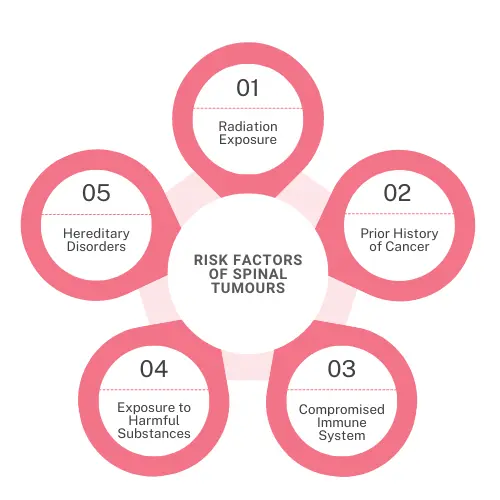
The exact cause of spinal tumours is still not fully known, however, it is related to a combination of factors including, genetic, environmental, and lifestyle factors. Below are the main causes:
The exact cause of primary spinal tumours are still idiopathic. However, the factors are associated with,
Genetic mutation: Tumors can sometimes run in families.
Immune system disorder: Weakened immune system may fail to suppress abnormal growths.
Radiation exposure: Radiation therapies or exposure to radiation trigger tumour formation.
Secondary spinal tumours occur due to metastatic disease. These tumours develop when cancer cells break away from the main tumour and spread through the bloodstream to the spine. The common primary cancer sources include,
– Breast Cancer
– Lung Cancer
– Prostate Cancer
– Kidney Cancer
– Thyroid Cancer
The symptoms of spinal tumours are affected by various factors including, the location, size, and type of tumour. Small tumors typically do not show any symptoms but as they get bigger they start to press against and irritate other tissues. The following are some typical signs of spinal tumors.
Back pain is a common sign of a spinal tumour. The discomfort may begin mildly and then progressively worsen. Conservative treatment methods may not be effective for back pain caused by tumours.
Numbness or loss of sensation in the back, legs, arms, or chest is a clear sign of a spinal tumour.
A spinal tumour can cause weakness in the muscles, it depends upon the location of the tumour, especially felt around the legs, arms, or chest.
A growing spinal tumour may compress the passing by nerves disrupting the nerve signal to the muscle, making it unable to make movements.
Tumours may lead to stiffness in the back and lead to difficulty making movement.
Other symptoms include stiffness in the back or neck, scoliosis, loss of bladder control, etc.
Primary spinal tumours are asymptomatic and are usually found incidentally during imaging tests for other reasons. A Spinal Tumor doctor can diagnose spinal tumours by performing a physical examination and asking about the symptoms, and medical history. The specialist may check for:
– Muscle weakness
– Sensitivity to pain
– Abnormal reflexes
Additionally, certain tests can be used to diagnose the spinal tumour including,
MRI: Gives a detailed image of the bone, vertebrae, etc.
X-ray: Provides a basic view of the spinal structure.
CT Scan: Helps create 2D images of the spine & provides a detailed view of abnormalities.
Biopsy: To detect if the tumour is cancerous or non-cancerous.
Blood Test: Helps identify abnormal areas in the spine.
Bone Scan: To check for abnormal levels of substances in the blood.
Treatment of spinal tumours depends on a number of factors including, the type of tumour (benign or malignant), location, size, and the patient’s overall health.
This is the preferred way of managing small benign tumours causing no or minimal symptoms. The goal is to monitor tumour growth.
This is the standard approach for malignant tumours, using rays to destroy tumour cells or shrink tumours.
Chemotherapy drugs help kill or slow down the growth of cancer cells. Chemotherapy is the preferred way of treatment for aggressive malignant tumours.
Surgery involves removing the tumour while preserving spinal cord and nerve function.
Some spinal tumors, especially primary spinal tumors are curable if completely removed, while spinal metastasis is non-curable.
No, spinal tumors are not common. Additionally, primary spinal tumors are rare, and metastatic spinal tumors are more prevalent.
The lethality of spinal tumors depends on their type, location, growth rate, and treatment timing. Malignant tumors are life-threatening if not treated/managed appropriately.
Yes, spinal tumors are benign. A majority of spinal tumors are benign (non-cancerous).
