“Why do I have a headache every day?”
It is one of the most common health questions people search online. If you experience headaches every day or find yourself searching for reasons for frequent headaches more and more often, this article is for you.
We will walk you through the most common causes of constant headaches, help you recognise warning signs that need medical attention, and explain when it is time to see a specialist.
Common Reasons for Frequent Headaches You Should Know
For millions of people, headaches are something they have to deal with daily, something they try to push through with a glass of water and a painkiller.
Most recurring headaches are not dangerous. They are, however, a sign from your body asking for medical attention.
Here are the most common causes of constant headaches:
- Stress and tension is the most widespread cause for everyday headaches. When you are anxious, overworked, or mentally strained, the muscles in your neck and scalp tighten, creating pain.
- Dehydration can cause or worsen a headache.
- Poor sleep, both too little and too much sleep can bring on headaches. Irregular sleep patterns disturbs your body’s natural rhythms.
- Screen time and eye strain caused by sitting hours in front of phones, laptops, and televisions force your eyes to work harder and your posture to suffer.
- Low blood sugar from irregular eating habits or skipping meals is a common headache trigger.
- Caffeine dependence. If you rely on multiple cups of coffee or tea daily, even missing one can cause a headache.
- Hormonal changes can also be the reason.
- Medication overuse like taking painkillers every time can lead to what doctors call a rebound or medication-overuse headache.
You first need to identify your personal triggers if you want to manage the recurring headaches.
Types of Recurring Headaches
Doctors classify them broadly as primary headaches (which are the condition themselves) and secondary headaches (which are symptoms of something else).
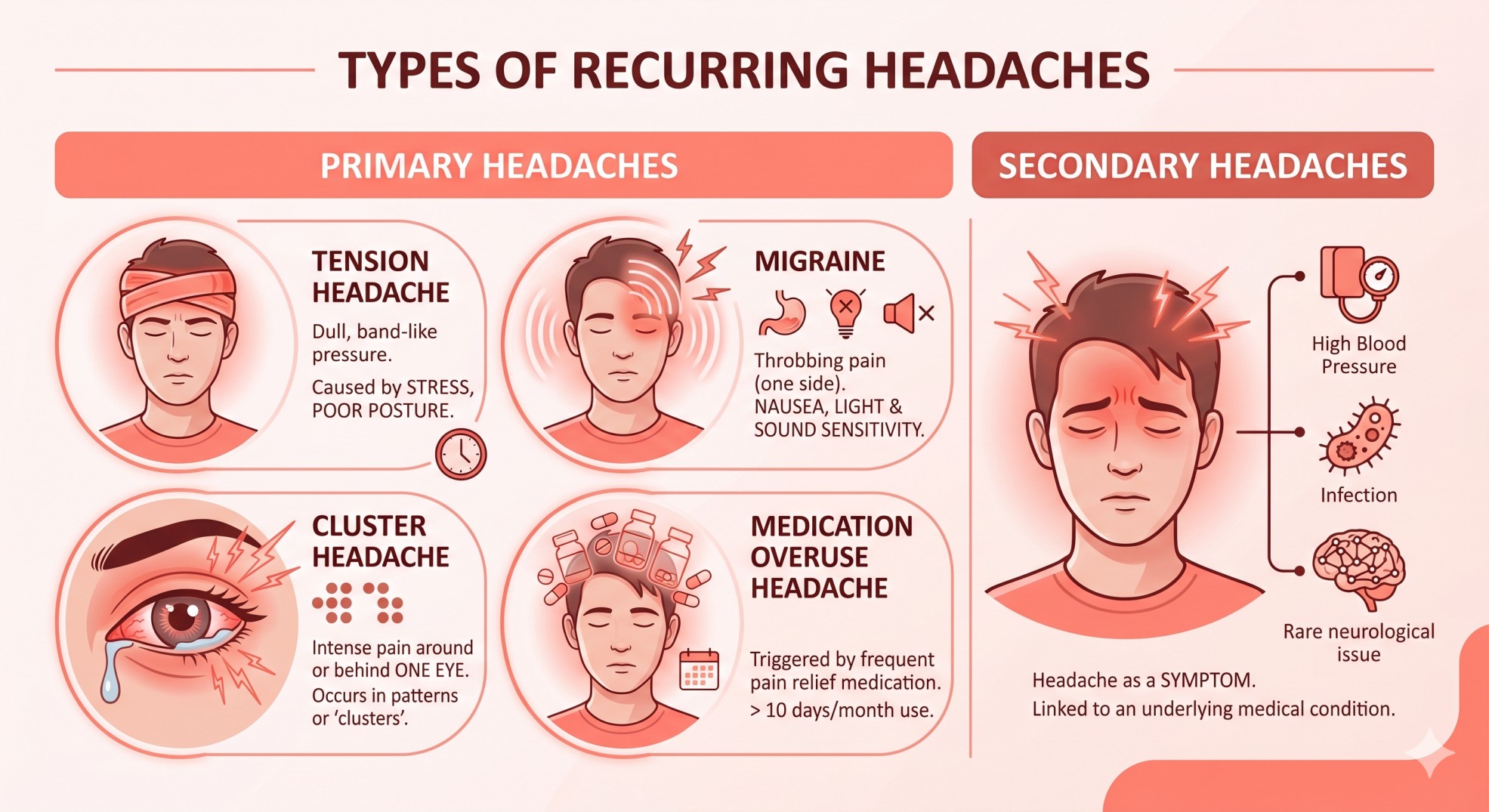
Here is what each common type looks like:
- Tension Headache
- The most common of all, this one feels like a dull, band-like pressure around your head. It can last anywhere from 30 minutes to several hours and is almost always linked to stress, poor posture, or fatigue.
- Migraine
- A migraine throbs on one side of the head and can last between 4 to 72 hours. It comes with nausea, vomiting, and a strong sensitivity to light and sound.
- Cluster Headache
- It is less common but intensely painful. This type of headache strikes around or behind one eye and can last 15 minutes to 3 hours. They tend to occur in patterns or clusters, the same time each day for weeks.
- Medication Overuse Headache
- This headache is caused by taking pain relief medicines too frequently. If you are reaching for a painkiller more than 10 days a month, the medication itself may now be driving your daily head pain.
- Secondary Headache
- Unlike the others, this is not a condition on its own. It is a symptom of some other medical problem happening in the body, such as high blood pressure, infection, or in rarer cases, a more serious neurological issue.
Warning Signs That Your Constant Headache Could Be Something Serious
The vast majority of daily headaches are linked to common lifestyle factors. However, a small but important number may be red-flag headaches that require urgent medical attention.
You should seek medical help timely if:
- Strikes suddenly and reaches maximum intensity within 60 seconds. This is called a thunderclap headache and can be the reason behind bleeding in the brain (subarachnoid haemorrhage).
- Is accompanied by a stiff neck, fever, and sensitivity to light. These together may be the sign of meningitis, a serious infection of the membranes surrounding the brain and spinal cord.
- Comes with neurological symptoms such as sudden weakness, numbness, vision changes, slurred speech, or confusion. These can be potential stroke signs requiring emergency care.
- Wakes you from sleep persistently, especially in the early morning hours.
- Is a new type of headache developing for the first time after the age of 50.
- Occurs after a head injury, even a seemingly minor one.
- Worsens over days or weeks without relief.
When to See a Neurologist
You must be wondering at what point does a recurring headache stop being “just a headache”. Do not delay seeing a doctor if you experience any of these signs:
- A continuous headache for days that does not respond to usual painkillers warrants medical evaluation.
- If you experience headaches more than 15 days a month for three or more consecutive months, this is defined as a chronic daily headache.
- If your headaches have changed in frequency, or intensity compared to your usual pattern.
- If headaches are interfering with your work, relationships, or daily functioning.
Treatment Options for Recurring Headaches
Most recurring headaches respond very well to the right treatment and lifestyle changes.
- Positive lifestyle changes like better sleep hygiene, regular mealtimes, staying hydrated, limiting caffeine, and stress management techniques such as yoga, mindfulness, or breathing exercises can help you deal with it.
- Identify what is triggering it. You can seek medical advice to know the cause, whether dietary, environmental, hormonal, or stress-related.
- Acute medications or short-term pain relief may be prescribed for occasional severe headaches.
- For people with frequent migraines or chronic daily headaches, low-dose medications as prescribed by the doctor, can reduce frequency and severity.
- Physiotherapy and posture correction are particularly helpful for tension-type and cervicogenic (neck-related) headaches.
- Psychological help like cognitive behavioral therapy may also help people manage chronic headache conditions, particularly when anxiety or depression are the reason behind it.
The right treatment depends on the type and pattern of your headaches which is exactly why a specialist assessment is important.
Conclusion
Frequent headaches are one of the most common health complaints, but that does not mean they should simply be taken lightly. In most cases, the reasons for headaches every day are treatable lifestyle factors. But some headaches do point to something more serious. If you are experiencing any of the red flag symptoms described in this article, do not delay consulting a healthcare specialist.
Our team of experienced neurologists at the CK Birla Hospital provides comprehensive care for all types of headache disorders. You can simply reach out to us or book a consultation to get the expert advice.