
Did you know? According to WHO, an estimated 619 million people suffer and live with lower back pain and it is the leading cause of disability worldwide.
Most of us have experienced lower back pain. Some have mild symptoms, while others have severe pain that interferes with daily living. Given the crucial role the spine plays in supporting the body, it is no wonder health experts advise us to always keep our back straight and adopt good posture.
Lumbosacral spondylolisthesis is a condition that affects the lower portion of the spine, which supports the upper body and facilitates movement. It is characterised by slippage or forward displacement of one vertebra (spinal bone) over the one beneath it. In addition to lower back pain and postural abnormalities, lumbosacral spondylolisthesis can cause weakness and make it difficult to walk, stand, and move.
Early detection and treatment is the recommended approach for the treatment of lumbosacral spondylolisthesis as severe or untreated cases may lead to chronic pain, permanent nerve damage, reduced mobility, and lead to serious complications. Age-related wear and tear of the spine is the leading cause of lumbosacral spondylolisthesis in older adults, while stress fracture and defects in the pars interarticularis (the bone connecting two vertebrae together) are the common cause of lumbosacral spondylolisthesis in young individuals.
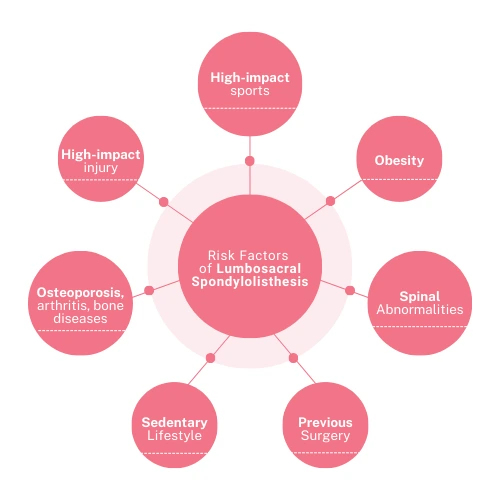
Lumbosacral spondylolisthesis in some cases develops with age while some are born with it. Some of the potential causes leading to lumbosacral spondylolisthesis include,
Congenital factors like malformation of the spine, birth defects, or any abnormal formation of the spine are key contributing factors leading to lumbosacral spondylolisthesis.
Lumbosacral spondylolisthesis caused by a defect or fracture in the pars interarticularis (the bone that connects two vertebrae together). Isthmic causes is the leading cause of lumbosacral spondylolisthesis in younger adults.
As we age the discs between the vertebrae wear out leading to instability and vertebral slippage. Degenerative changes are a major contributing factor leading to lumbosacral spondylolisthesis in older adults.
Trauma or injury from car accidents, falls, or sports injuries can disrupt the spinal alignment and result in vertebral slippage.
Vertebral slippage is also caused by diseases or conditions that weaken the spine’s structure like infections, bone tumours, osteoporosis, etc.
Any prior spinal surgery like spinal fusion, laminectomy, etc can alter the spinal mechanics and affect the spine’s stability leading to conditions like spondylolisthesis.
The degree of slippage, its underlying cause and whether it compresses the spinal cord or surrounding nerves all affect the symptoms of lumbosacral spondylolisthesis. While some people with lumbosacral spondylolisthesis may only have minor or no symptoms others may have severe pain (persistent or intermittent). Some of the common symptoms include,
Low back pain is the most common symptom of vertebral slippage. The pain may worsen while walking, bending, standing, etc.
Individuals suffering from lumbar spine vertebral slippage may experience reduced flexibility and difficulty in performing activities involving bending, twisting, etc.
Lumbosacral spondylolisthesis may lead to nerve root compression resulting in radiating pain into the buttocks, thighs, and legs.
The slippage of vertebrae may lead to nerve compression or irritation causing sensations in the legs and feet.
One of the clear signs of lumbosacral spondylolisthesis is muscle weakness in the legs or feet caused by nerve root compression due to slippage of vertebrae.
A rare though severe symptom of lumbosacral spondylolisthesis is loss of bladder control.
Through imaging tests and physical examination, a spine specialist can diagnose lumbar spondylolisthesis. Finding the painful area, and assessing the surrounding muscle strength, sensations, reflexes, postural changes, etc. can be aided by this physical examination. To check for any pain or abnormalities the spine specialist might ask you to walk, bend, and stand up straight. To determine the precise cause the specialist may also inquire about the patient’s medical history, pain areas, and family medical history.
After performing a physical examination the specialist might recommend specific imaging tests to ascertain the nature and extent of the problem. These imaging tests can be used to diagnose lumbosacral spondylolisthesis.
The treatment approach for lumbosacral spondylolisthesis varies depending on the severity of vertebral slippage, symptoms, and whether there is nerve or spinal cord compression. There are two categories of treatment options: i. e. surgical and conservative/non-surgical methods. The severity of the condition determines whether non-surgical or surgical options are used for treatment. Additionally, early diagnosis and customised treatment plans are important for improving outcomes and preventing complications.
The National Institutes of Health (NIH) has characterised spondylolisthesis into five grades according to the severity of vertebral slippage.
Grade I: Slippage of 1% to 25% of the vertebral body.
Grade II: Slippage of 26% to 50% of the vertebral body.
Grade III: Slippage of 51% to 75% of the vertebral body.
Grade IV: Slippage of 76% to 100% of the vertebral body.
Grade V: Complete slippage of the vertebra beyond 100%.Low-grade spondylolisthesis grades I and II can be managed conservatively with bracing, physical therapy, and medication, while high-grade spondylolisthesis, grades IV and V need to be treated surgically.
These include controlling the symptoms with conservative measures. Non-surgical treatments are typically advised for people with mild symptoms and low-grade spondylolisthesis and include wearing a brace to stabilize the spine, taking over-the-counter medications to relieve pain and discomfort, and routinely seeing a doctor to monitor changes. Alternative therapies such as physical therapy can also be used to help relieve stress and strengthen muscles.
Surgery is recommended for those with more severe symptoms if the slippage is more than 50%. Surgery may be required for severe pain that makes it difficult to walk, stand, use fine motor skills, and perform physical activities. A specialist may suggest surgery if non-operative treatment options are unsuccessful. Lumbosacral spondylolisthesis is treated surgically with spinal fusion, spinal decompression and other techniques.
Lumbosacral spondylolisthesis is a condition that affects the lower portion of the spine that supports the upper body and facilitates movement. It is characterised by slippage or forward displacement of one vertebra (spinal bone) over the one beneath it.
No, lumbar spondylosis is not fully curable. However, the symptoms can be managed through surgical & non-surgical treatment approaches.
There are two categories of treatment options for managing lumbar spondylolisthesis i. e. surgical and conservative/non-surgical methods. The treatment approach varies depending on the severity of vertebral slippage, symptoms, and whether there is nerve or spinal cord compression.
No, spondylolisthesis cannot be fully reversed.


