
Are you curious about your peak fertility days? With the help of this ovulation calculator, you can track the optimal days for conception, boosting your chances of pregnancy and making informed decisions about starting a family.
This ovulation calculator is easy to use and includes a few simple steps to get personalized outcomes. The following steps will help you track your most fertile days:
The ovulation calculator then provides you with the estimated date range, i.e. most fertile window along with other important factors such as next period date, pregnancy test date, expected due date and best days to conceive.
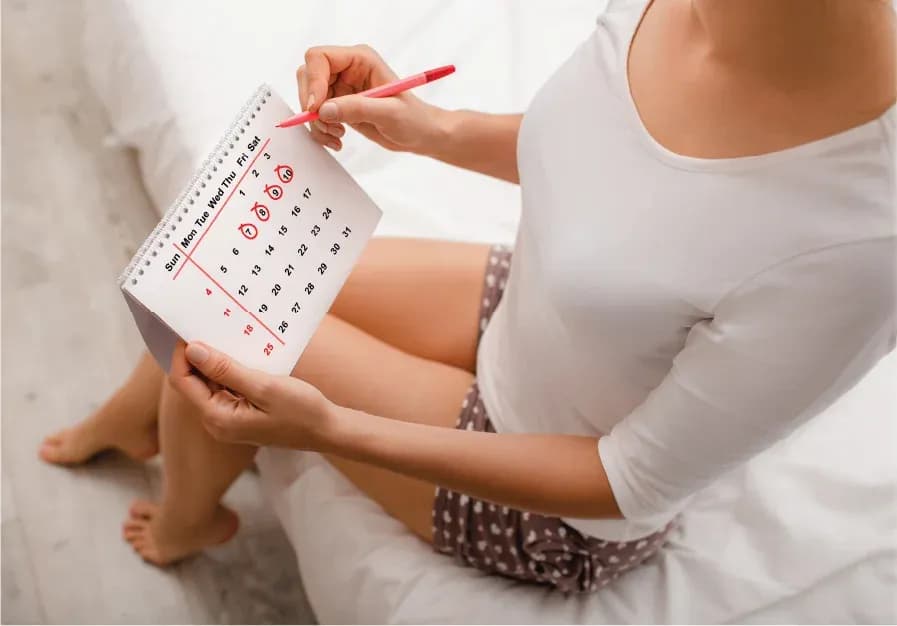

Analyzes menstrual cycle data to pinpoint peak fertility days for conception.

Identifies the ideal window for intercourse to significantly maximize the likelihood of pregnancy.

Equips users with valuable insights to adopt healthy lifestyle habits and seek timely medical guidance.

Helps women systematically organize their conception attempts around their natural biological cycles.

Grants women greater control and awareness over their personal fertility and bodily rhythms.

Provides a reliable roadmap and essential timelines throughout the family-planning process.
Talk to our experts
 Speak to our expert
Understanding ovulation is key to identifying the best time to get pregnant, which requires familiarity with your menstrual cycle.

The menstrual cycle is a monthly biological process that prepares the body for a potential pregnancy. A typical cycle lasts between 24 and 38 days, while an individual period generally lasts from 3 to seven days (with flow varying from person to person).
The cycle begins on the first day of a period, which occurs when the uterine lining sheds. It is broken down into four main phases:
Recognizing the signs of ovulation can help you pinpoint your fertile window and better plan for pregnancy. Common indicators include:



Talk to our experts
Speak to our expertFact: False. While your fertile window spans several days, you do not need to have intercourse every single day. Engaging in intercourse a few times throughout this window is sufficient to achieve conception.
Fact: False. Although periods are not the most fertile time of the month, ovulation timing can shift from cycle to cycle. Because sperm can also survive in the reproductive tract for up to five days, early ovulation or overlapping timelines mean there is still a small possibility of conception during a period.
Ovulation is the process where your body releases an egg from the ovary. Consider this as a natural indication that your body is getting ready for pregnancy. Once the egg is released it travels through the fallopian tube, where it meets the sperm.
This step is very important for conception. Without ovulation there is no egg for fertilisation, which means pregnancy cannot happen successfully. Simply put, ovulation is the time when your body’s most ready to conceive.
Ovulation doesn’t happen on the same date of the menstrual cycle for everyone. It depends on your cycle length. In a typical 28-day cycle, ovulation usually happens around day 14. But the important part is, ovulation occurs about 12–14 days before your next period starts, and not necessarily in the middle of the month.
So if your cycle is longer than 28 days your ovulation day will be different. Understanding your cycle pattern is key to identifying your most fertile days.
Ovulation itself is very short. It usually lasts 12 to 24 hours. During this time the egg is available to be fertilised. If it does not meet sperm within this time it naturally breaks down and gets absorbed by the body. That is why timing plays such a role when trying to conceive.
Your fertile window is the time when your chances of getting pregnant’re highest. It includes the 5 days leading up to ovulation and the day of ovulation itself.
This is because a healthy sperm can live inside the body for up to 5 days waiting for the egg to be released. So even if intercourse happens days before ovulation, pregnancy is still possible.
An ovulation calculator gives you an idea, a near perfect estimate, especially if your periods are regular.
However it is important to remember that it works based on averages. Your body may not follow the same pattern every month so the prediction may not always be exact. This is especially true if your cycles are irregular.
The calculator uses two details: the first day of your last period and your average cycle length. Based on this it predicts when you are most likely to ovulate and highlights your window. This helps you plan better if you are trying to conceive.
An ovulation calculator is a starting point, however, it is best used along with other signs your body gives you. For accuracy you can combine it with
These methods together give a picture of your fertility window.
You only need two details: the first day of your last menstrual period and your average cycle length. The more accurate this information is, the more reliable your ovulation prediction will be.
If your periods are irregular, your ovulation may not follow a pattern, making it less predictable. In such situations, an ovulation calculator may not be very accurate.
If you frequently experience irregularity in your cycles, it is a good idea to consult a doctor to understand the underlying cause and get personalised guidance.
Yes, they can, and that’s completely normal. Ovulation can shift slightly from month to month due to factors, like stress, illness, travel and hormonal changes.
With regular cycles a little variation is expected. Your ovulation dates can change every month. That is okay.

