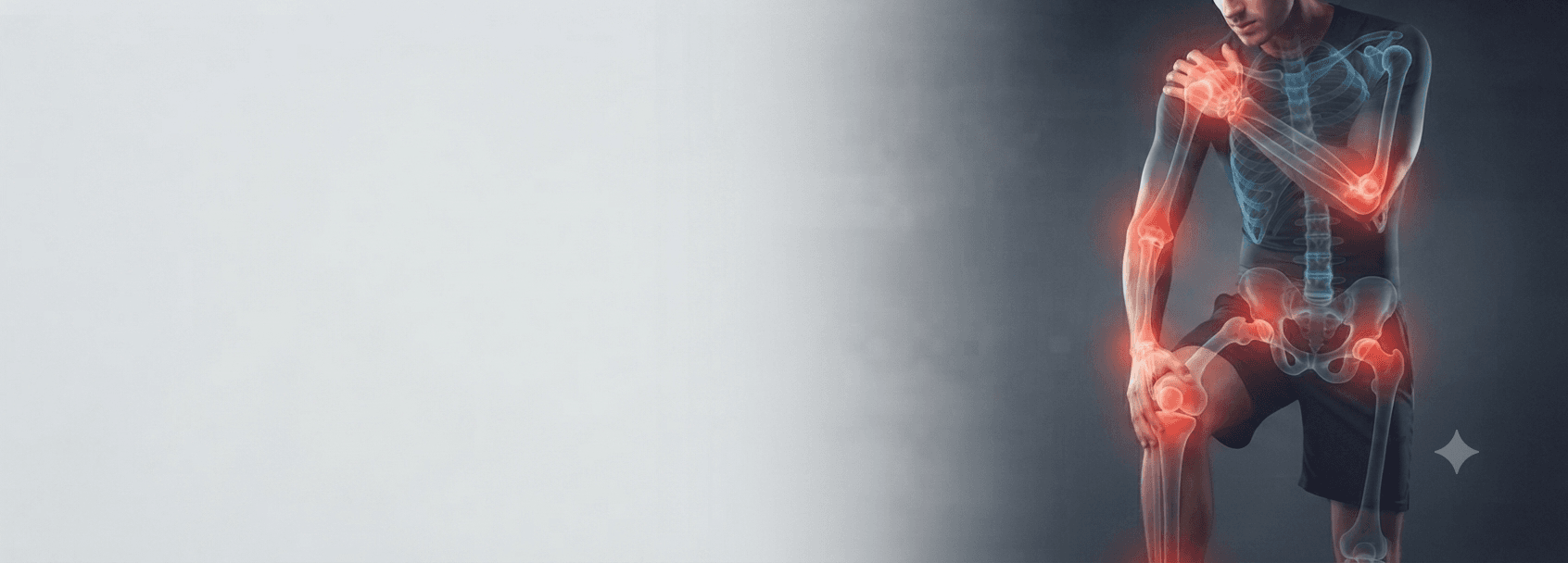
The most common cause is osteoarthritis, where the cartilage that cushions the ends of bones gradually wears away. Once the cartilage is gone, bone rubs on bone, producing pain, swelling, and stiffness that worsens with activity and improves briefly with rest. It is most common in the knees, hips, and small joints of the hands.
Rheumatoid arthritis is different. It is an autoimmune condition in which the immune system attacks the joint lining, causing inflammation, progressive joint damage, and systemic symptoms including fatigue and morning stiffness lasting more than an hour.
Gout develops when uric acid crystals accumulate in a joint, most commonly the big toe, ankle, or knee. Attacks come on suddenly, often overnight, and produce intense pain, redness, and swelling. They resolve on their own but recur without treatment of the underlying uric acid levels.
Ligament and tendon injuries from sport, falls, or overuse cause joint pain in younger patients. An ACL tear, rotator cuff injury, or lateral ankle sprain each produce joint pain from different mechanisms like instability, impingement, or inflamed tissue, requiring different treatment.
Bursitis is inflammation of the small fluid-filled sacs that cushion the joint. It produces localised, often sharp pain that is worse with specific movements. Common sites include the shoulder, elbow, hip, and knee.
Septic arthritis is a joint infection requiring urgent treatment. It causes sudden onset severe pain, warmth, swelling, and fever. It is a medical emergency; delayed treatment leads to permanent joint destruction.
Ankylosing spondylitis, psoriatic arthritis, and other inflammatory arthropathies cause joint pain with a characteristic pattern – worse in the morning, improves with movement, and associated with other features such as skin or eye involvement, that distinguish them from mechanical joint disease.
Joint pain that is dismissed as normal ageing and left unmanaged tends to progress. The cartilage continues to wear; the joint continues to degrade.
For osteoarthritis, delayed treatment means the patient continues loading a joint without the cartilage protection that reduces that load. Over months the joint space narrows further, surrounding muscles weaken from disuse, and what was a manageable ache becomes pain that limits sleep and all physical activity. By the time surgery is considered, the joint is more severely damaged and recovery is harder.
For inflammatory arthritis including rheumatoid and psoriatic arthritis, untreated disease causes permanent structural joint damage within months of onset. The window for disease-modifying treatment is early; waiting costs joint integrity that cannot be restored.
For septic arthritis, every hour of delay increases the risk of permanent joint damage. Delayed treatment can destroy a joint completely within days.


Osteoarthritis: cartilage breakdown in weight-bearing and frequently used joints, most commonly the knee, hip, shoulder, and hand. Causes deep aching pain, stiffness after rest, swelling, and eventually reduced range of motion.
Rheumatoid Arthritis: autoimmune joint inflammation that affects multiple joints symmetrically, causes morning stiffness lasting over an hour, and produces systemic symptoms alongside joint damage. Requires early specialist management to prevent structural destruction.
Gout: sudden, severe joint inflammation caused by uric acid crystal deposition. The big toe, ankle, and knee are most commonly affected. Attacks resolve spontaneously but recur and cause long-term joint damage without management of uric acid levels.
Ligament Injuries (ACL, MCL, PCL): tears or sprains of the ligaments stabilising the knee, shoulder, or ankle from sport or trauma. Causes instability, swelling, and pain with loading or specific movements.
Bursitis: inflammation of the bursa sacs cushioning the joint, producing localised pain that is worse with specific movements. Common in the shoulder, elbow, hip, and kneecap region.
Tendinitis: inflammation of tendons at or near the joint from overuse or repetitive strain. Common presentations include tennis elbow, golfer’s elbow, rotator cuff tendinitis, and patellar tendinitis.
Frozen Shoulder (Adhesive Capsulitis): progressive stiffening and pain of the shoulder joint caused by inflammation and thickening of the joint capsule. Passes through predictable painful, frozen, and thawing phases over 1 to 3 years without treatment, but responds well to early physiotherapy and injection therapy.
Septic Arthritis: bacterial infection of a joint requiring urgent joint washout and intravenous antibiotics. Presents with sudden severe pain, warmth, swelling, and fever in a single joint.
Psoriatic and Inflammatory Arthritis: joint inflammation associated with psoriasis or other systemic conditions. Causes pain, swelling, and morning stiffness and requires disease-modifying drug therapy.
Physiotherapy is the first-line treatment for most mechanical joint pain. A structured programme builds the muscles around the joint, reduces load on the damaged surface, improves range of motion, and, in the case of ligament injuries, restores neuromuscular control and stability. Physiotherapy is available on-site at CK Birla Hospital and is used alongside other treatments rather than as an alternative to them.
Weight management reduces the load through weight-bearing joints directly. Each kilogram of body weight translates to roughly four kilograms of force through the knee during walking. A reduction of 5 to 10 kilograms produces measurable improvement in knee and hip pain in overweight patients with osteoarthritis.
Joint injections, including corticosteroid and hyaluronic acid injections, are used to reduce inflammation and improve joint lubrication in osteoarthritis. They provide pain relief over weeks to months and are used when physiotherapy needs support or when acute inflammation is limiting progress.
PRP (Platelet-Rich Plasma) Therapy uses growth factors from the patient’s own blood, injected into the joint, to stimulate tissue repair and reduce inflammation. It is used for mild to moderate osteoarthritis, tendon injuries, and ligament damage where structural surgery is not required.
Disease-Modifying Anti-Rheumatic Drugs (DMARDs) are the foundation of treatment for rheumatoid arthritis, psoriatic arthritis, and ankylosing spondylitis. They reduce immune-mediated joint inflammation and slow or prevent structural joint destruction. Biological DMARDs, including TNF inhibitors, are used when conventional DMARDs have not produced adequate disease control.
Arthroscopy is a minimally invasive procedure in which a camera and instruments are introduced into the joint through small incisions. It is used to diagnose and treat a range of joint problems including loose bodies, meniscal tears, ligament reconstruction, and cartilage repair. Most arthroscopic procedures are day-surgery with recovery over 2 to 6 weeks depending on what is performed.
ACL Reconstruction rebuilds the anterior cruciate ligament using a tendon graft from the patient’s own knee or donor tissue. It is recommended for active patients with ACL tears causing instability that limits sport or daily activity.
Cartilage Restoration Procedures including microfracture, osteochondral autograft transfer, and autologous chondrocyte implantation treat focal cartilage defects in younger patients before osteoarthritis has progressed across the whole joint surface.
Total and Partial Joint Replacement is recommended for end-stage arthritis where cartilage loss is widespread and pain and functional limitation are severe. Knee replacement is the most common; hip replacement the second. Both are among the most successful operations in surgery, with over 90% of patients reporting substantial pain reduction and functional improvement at 10 years.
Joint Lavage and Washout for septic arthritis involves urgent irrigation and debridement of the infected joint under anaesthesia, combined with intravenous antibiotics. Early surgical washout is the single most important factor in preventing permanent joint damage from joint infection.
Weight management is the most modifiable risk factor for knee and hip osteoarthritis. Keeping body weight within a healthy range slows cartilage wear and delays the need for joint replacement. Exercise regularly with a focus on low-impact activities such as swimming, cycling, and walking place less compressive stress on the joints than running or jumping while maintaining the muscle strength that protects them. Warm up before exercise and cool down after; cold, unwarmed muscles transfer more force to joints. Avoid prolonged postures that load a single joint, crossing the legs for long periods, squatting repeatedly, or kneeling on hard surfaces all increase joint stress over time. Treat acute joint injuries promptly; a ligament sprain that is not rehabilitated properly leads to joint instability and accelerated cartilage wear years later.
The consultation covers the location, onset, and character of the pain, whether it is worse with activity or at rest, any history of injury or previous treatment, and the impact on daily function. A physical examination assesses the affected joint for swelling, warmth, range of motion, ligament stability, and specific provocation tests that help identify the structure involved.
X-ray shows bone alignment, joint space width, and bony changes including osteophytes and subchondral sclerosis. It is the standard first imaging investigation for suspected osteoarthritis and post-traumatic joint problems. MRI provides detail of the soft tissues, cartilage, ligaments, tendons, and the joint lining and is used for ligament injuries, cartilage assessment, early avascular necrosis, and where soft tissue pathology is suspected. Ultrasound is used to assess tendons, bursae, and fluid in the joint in real time, and to guide injection procedures accurately. Blood tests including rheumatoid factor, anti-CCP antibodies, uric acid, ESR, and CRP are used when inflammatory or crystal arthritis is suspected. Joint fluid analysis, where fluid is aspirated from a swollen joint and examined microscopically, confirms the presence of infection, gout crystals, or inflammatory cells and directly determines the treatment course.
At the first consultation, bring any previous imaging including X-rays or MRI reports, a list of current medications including NSAIDs and supplements, and details of any previous joint injections or physiotherapy. If blood thinners are prescribed, inform the specialist, as these affect the timing and safety of injection procedures and surgery. For inflammatory arthritis, bring previous rheumatology letters and the names and doses of any DMARDs currently taken.
If surgery is planned, the specialist advises on stopping blood thinners at a specific interval before the procedure. Arrange for someone to accompany you to and from the hospital. Stop smoking before elective joint surgery; smoking impairs bone healing, increases infection risk, and lengthens recovery.
After joint injection therapy, rest the joint for 24 hours and avoid strenuous activity for 48 hours to allow the medication to work. Minor soreness at the injection site in the first 24 to 48 hours is normal. If the joint becomes hot, swollen, and increasingly painful after an injection, contact the clinic promptly as this may indicate a post-injection flare or, rarely, an infection.
After arthroscopic surgery, most patients are weight-bearing the same day or the day after. Use crutches for the period advised by the surgeon. Physiotherapy starts within 1 to 2 weeks. Most patients return to light activity within 4 to 6 weeks; return to sport depends on what was performed and ranges from 6 weeks to 6 months.
After joint replacement, physiotherapy begins on the first post-operative day. The goal is full weight-bearing and walking with a frame within 24 hours of knee replacement and within 24 to 48 hours of hip replacement. Avoid positions that risk dislocation of the new hip joint — the physiotherapy team provides specific instructions. Full recovery and return to all activity is assessed at the 3-month review; most patients are walking without a stick by 6 to 8 weeks.
Continue prescribed anti-inflammatory or DMARD medication after treatment. Do not stop disease-modifying drugs without specialist advice, even when joints feel better, inflammatory arthritis is controlled by the medication, not resolved by it.
Recovery timelines vary widely by condition and treatment. Physiotherapy for tendinitis or mild osteoarthritis produces improvement over 6 to 12 weeks. Arthroscopic meniscal repair requires 4 to 6 months before return to full sport. ACL reconstruction takes 9 to 12 months for return to contact sport, with a structured rehabilitation programme throughout.
Joint replacement recovery follows a predictable path. Most patients walk short distances within 2 days. Stairs are managed within 1 to 2 weeks. Driving returns at 4 to 6 weeks for the right knee and around 4 weeks for hip replacement. By 3 months most patients are walking without aids and managing all activities of daily living. Pain levels at one year are substantially lower than before surgery in over 90% of knee and hip replacement patients.
For inflammatory arthritis, improvement from DMARD therapy builds over weeks to months. Most patients see a meaningful reduction in joint swelling and stiffness within 6 to 12 weeks of starting effective treatment.
Joint pain that persists more than 2 weeks, pain with swelling, warmth, or redness in the joint, pain that limits walking, climbing stairs, or sleep, or a joint that feels unstable should be assessed by a specialist rather than managed with over-the-counter medication alone.
No. Weight management, physiotherapy, activity modification, joint injections, and PRP therapy are all non-surgical options that delay or in some cases prevent the need for joint replacement. Surgery is considered when these have not provided enough relief and pain and functional limitation are severe.
Modern knee and hip replacements last 15 to 20 years in most patients. Younger and more active patients may need revision surgery earlier. Implant longevity depends on the patient’s activity level, weight, and how well they follow post-operative rehabilitation.
Gout attacks can be stopped and prevented. The underlying elevated uric acid, however, does not resolve on its own. Urate-lowering medication taken consistently keeps uric acid levels below the threshold at which crystals form, preventing future attacks and the joint damage that accumulates from repeated episodes.
Yes. Physiotherapy after spine surgery is a standard part of recovery. It starts at the time the operating surgeon specifies, typically 4 to 6 weeks post-operatively, and is not optional — it protects the repair and reduces the risk of recurrence.