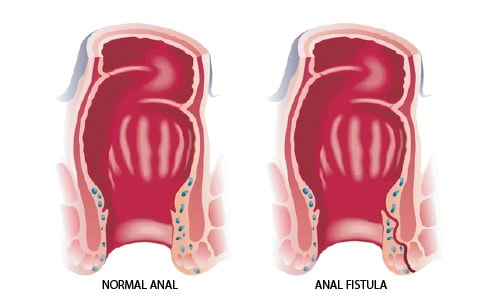
Fistulas can occur for various reasons, depending on their type and location. Here are some common causes:
Prompt medical attention is crucial for appropriate management and prevention of complications.
If a fistulotomy is not done timely and properly, several risks and complications may arise, like:
Timely and proper treatment is essential to minimise these risks and complications. Patients should discuss options and post-operative care with healthcare providers.
Fistulas manifest in various bodily locations, categorised by their specific anatomical connections:
Additionally, there are Gastrocutaneous, Tracheoesophageal, and Arteriovenous Fistulas, each presenting distinct challenges and treatment approaches.
A fistulotomy, a surgical treatment for anal fistulas, encompasses various techniques, which are:
The choice depends on factors like location, complexity, and patient health. Consulting a healthcare professional is crucial for personalised treatment.
Preventing fistulas depends on the underlying causes. Here are some general strategies to prevent fistulas:
These measures collectively mitigate the risk of developing fistulas.


GI, Minimal Access & Bariatric Surgeon
GI, Minimal Access and Bariatric surgery
28+ Years Experience
Gurgaon

GI, Minimal Access & Bariatric Surgeon
GI, Minimal Access and Bariatric surgery
27+ Years Experience
Gurgaon
The diagnostic process for a fistulotomy may include:
Medical History
Physical Examination
Imaging Studies
Before undergoing a fistulotomy, it’s crucial to follow these specific pre-treatment instructions:
Following these instructions ensures the procedure’s success and minimises complications.
Post-surgery instructions for a fistulotomy typically include:
Recovering from a fistulotomy involves several key steps, such as:
Patience is crucial; healing may take several weeks. Follow your doctor’s instructions diligently.
A fistulotomy is a surgical procedure used to treat anal fistulas by cutting open the fistula tract to allow it to heal from the inside out, promoting drainage and closure.
During a fistulotomy, a surgeon makes an incision along the fistula tract, removes infected tissue, and opens the tract to allow it to heal naturally, promoting drainage and closure.
Conditions or diseases that might necessitate a fistulotomy include anal fistulas, which can develop due to infections, inflammatory bowel disease (such as Crohn’s disease), or trauma to the anal region.
Recovery from a fistulotomy typically takes a few weeks. Patients may experience discomfort, swelling, and drainage initially, but symptoms usually improve gradually as the surgical site heals.

