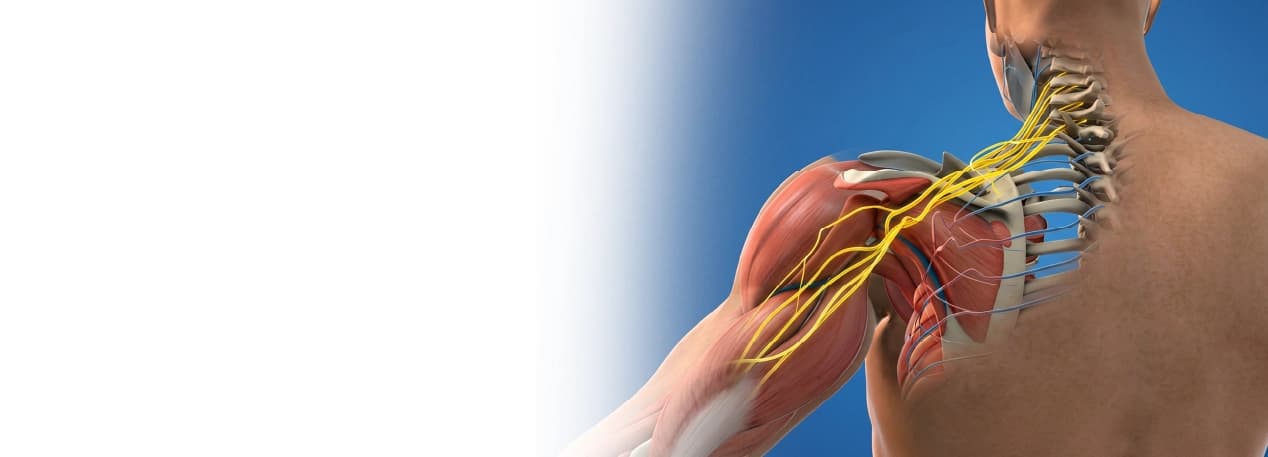
neck and travels through the shoulder into the arm and hand. These nerves control almost every movement of the upper limb, including lifting the shoulder, bending the elbow, extending the wrist, gripping objects and performing fine finger movements. They also carry sensations such as touch, pain and temperature from the arm back to the brain.
When these nerves are stretched, compressed or torn, communication between the brain and the arm is disrupted. As a result, a person may experience weakness, numbness, severe pain or even complete paralysis of the affected arm.
The severity of a brachial plexus injury depends on the extent of nerve damage.
Brachial plexus injuries are classified by severity into four types:
Many injuries involve more than one type of damage across different nerve roots, which is why imaging and electrodiagnostic testing matter for planning treatment.
A brachial plexus injury usually occurs when the shoulder is forced downward while the neck is stretched in the opposite direction, placing excessive tension on the nerves.
Common causes include:
In newborns, brachial plexus injuries can occur during delivery, particularly when the baby’s shoulder becomes stuck in the birth canal (shoulder dystocia). This is sometimes referred to as Erb’s palsy (upper plexus) or Klumpke’s palsy (lower plexus), depending on which nerve roots are affected.
Symptoms vary depending on which nerves are affected and whether the injury is mild or severe.
Common symptoms include:
Severe injuries may leave the arm completely limp and without sensation. Upper plexus injuries (C5–C6) typically affect shoulder and elbow movement, while lower plexus injuries (C8–T1) affect the hand and wrist. Total plexus injuries (C5–T1) can leave the entire arm paralysed and without sensation.
If symptoms occur after an accident or significant trauma, they should never be ignored.
Prompt medical evaluation is important because it can be difficult to determine whether a nerve is simply stretched or completely torn.
Consult a specialist immediately if you experience:
Some nerve injuries recover naturally, but others require surgery within three to six months for the best functional outcome. If you or someone with you has arm weakness or numbness after a fall, accident, or sports collision, get it checked the same day rather than waiting to see if it resolves on its own. Waiting too long may result in irreversible muscle wasting and reduced chances of recovery.
Diagnosing a brachial plexus injury begins with a detailed medical history and physical examination.
Your specialist will assess:
Depending on your condition, additional investigations may include:
Because nerve injuries evolve over time, repeat EMG testing may be recommended a few weeks after the initial injury to assess recovery.
Treatment is tailored according to the type of injury, severity of nerve damage, age of the patient and the time elapsed since the injury.
Patients with mild stretch injuries often recover without surgery.
Rehabilitation is the cornerstone of recovery. A personalised physiotherapy programme helps:
Occupational therapy also helps patients adapt daily activities during recovery.
Nerve injuries often cause severe neuropathic pain.
Treatment may include:
Effective pain control improves comfort and supports rehabilitation.
Special braces may be recommended to support the affected arm, maintain proper joint positioning and prevent deformities while the nerves heal.
Surgery is recommended when the nerves are torn, avulsed or fail to recover with conservative treatment. The goal is to restore as much movement and function as possible.
When a nerve is ruptured, surgeons may bridge the damaged segment using a healthy nerve taken from another part of the body. This creates a pathway for nerve fibres to regenerate.
If the nerve has been pulled away from the spinal cord, direct repair is not possible. In these cases, a nearby healthy nerve with a less critical function is redirected to restore movement in important muscles such as those controlling the shoulder or elbow.
When nerve recovery is unlikely or delayed, tendons from functioning muscles can be repositioned to improve movement and restore useful arm function.
In selected patients with long-standing injuries, surgeons may transplant a healthy muscle along with its blood vessels and nerve supply to improve movement of the arm.
The choice of surgery depends on the injury pattern, time since injury and the patient’s functional goals.
Recovery from a brachial plexus injury is slow. Nerves regenerate at roughly 1 mm per day (about 2.5 cm per month), and the further the injury site is from the target muscle, the longer recovery takes. Setting realistic expectations from the start is an important part of treatment.
Consistent physiotherapy throughout the recovery period is critical. Without it, joints stiffen, muscles atrophy further, and even successful nerve repair may not translate into useful arm function.
It is damage to the network of nerves that connects the spinal cord to the shoulder, arm, and hand. These nerves control both movement and sensation in the upper limb, so an injury can cause weakness, numbness, pain, or paralysis depending on severity.
In adults, motorcycle and motor vehicle accidents are the leading cause. Falls, contact sports injuries, and penetrating trauma (stab or gunshot wounds) are also common. In newborns, the injury can happen during a difficult delivery when the shoulder gets stuck in the birth canal.
Recovery is gradual. After nerve grafting, the first signs of muscle recovery typically appear 6 to 12 months after surgery, with improvement continuing for up to two to three years. Nerve transfers can produce earlier results, around 4 to 9 months. Physiotherapy throughout the recovery period is essential for achieving the best functional outcome.
No. Mild stretch injuries often recover with physiotherapy and time alone. Surgery is recommended for nerve ruptures and avulsions, or for injuries that show no improvement on clinical and electrodiagnostic testing after a monitoring period (usually three to six months, depending on the injury pattern).
Yes. Most birth-related brachial plexus injuries (Erb’s palsy) resolve within three to four months with physiotherapy. Babies who don’t show improvement within that window may need surgical exploration, and early referral to a specialist is recommended.